Get trending papers in your email inbox once a day!
Get trending papers in your email inbox!
SubscribeInvestigating Efficiently Extending Transformers for Long Input Summarization
While large pretrained Transformer models have proven highly capable at tackling natural language tasks, handling long sequence inputs continues to be a significant challenge. One such task is long input summarization, where inputs are longer than the maximum input context of most pretrained models. Through an extensive set of experiments, we investigate what model architectural changes and pretraining paradigms can most efficiently adapt a pretrained Transformer for long input summarization. We find that a staggered, block-local Transformer with global encoder tokens strikes a good balance of performance and efficiency, and that an additional pretraining phase on long sequences meaningfully improves downstream summarization performance. Based on our findings, we introduce PEGASUS-X, an extension of the PEGASUS model with additional long input pretraining to handle inputs of up to 16K tokens. PEGASUS-X achieves strong performance on long input summarization tasks comparable with much larger models while adding few additional parameters and not requiring model parallelism to train.
M4LE: A Multi-Ability Multi-Range Multi-Task Multi-Domain Long-Context Evaluation Benchmark for Large Language Models
Managing long sequences has become an important and necessary feature for large language models (LLMs). However, it is still an open question of how to comprehensively and systematically evaluate the long-sequence capability of LLMs. One of the reasons is that conventional and widely-used benchmarks mainly consist of short sequences. In this paper, we propose M4LE, a Multi-ability, Multi-range, Multi-task, Multi-domain benchmark for Long-context Evaluation. M4LE is based on a diverse NLP task pool comprising 36 NLP datasets, 11 task types and 12 domains. To alleviate the scarcity of tasks with naturally long sequences and incorporate multiple-ability assessment, we propose an automatic approach (but with negligible human annotations) to convert short-sequence tasks into a unified long-sequence scenario where LLMs have to identify single or multiple relevant spans in long contexts based on explicit or semantic hints. Specifically, the scenario includes five different types of abilities: (1) explicit single-span; (2) semantic single-span; (3) explicit multiple-span; (4) semantic multiple-span; and (5) global context understanding. The resulting samples in M4LE are evenly distributed from 1k to 8k input length. We conducted a systematic evaluation on 11 well-established LLMs, especially those optimized for long-sequence inputs. Our results reveal that: 1) Current LLMs struggle to understand long context, particularly when tasks require multiple-span attention. 2) Semantic retrieval task is more difficult for competent LLMs. 3) Models fine-tuned on longer text with position interpolation have comparable performance to those using Neural Tangent Kernel (NTK) aware scaling methods without fine-tuning. We make our benchmark publicly available to encourage future research in this challenging area.
LaMamba-Diff: Linear-Time High-Fidelity Diffusion Models Based on Local Attention and Mamba
Recent Transformer-based diffusion models have shown remarkable performance, largely attributed to the ability of the self-attention mechanism to accurately capture both global and local contexts by computing all-pair interactions among input tokens. However, their quadratic complexity poses significant computational challenges for long-sequence inputs. Conversely, a recent state space model called Mamba offers linear complexity by compressing a filtered global context into a hidden state. Despite its efficiency, compression inevitably leads to information loss of fine-grained local dependencies among tokens, which are crucial for effective visual generative modeling. Motivated by these observations, we introduce Local Attentional Mamba (LaMamba) blocks that combine the strengths of self-attention and Mamba, capturing both global contexts and local details with linear complexity. Leveraging the efficient U-Net architecture, our model exhibits exceptional scalability and surpasses the performance of DiT across various model scales on ImageNet at 256x256 resolution, all while utilizing substantially fewer GFLOPs and a comparable number of parameters. Compared to state-of-the-art diffusion models on ImageNet 256x256 and 512x512, our largest model presents notable advantages, such as a reduction of up to 62\% GFLOPs compared to DiT-XL/2, while achieving superior performance with comparable or fewer parameters.
mPLUG-Owl3: Towards Long Image-Sequence Understanding in Multi-Modal Large Language Models
Multi-modal Large Language Models (MLLMs) have demonstrated remarkable capabilities in executing instructions for a variety of single-image tasks. Despite this progress, significant challenges remain in modeling long image sequences. In this work, we introduce the versatile multi-modal large language model, mPLUG-Owl3, which enhances the capability for long image-sequence understanding in scenarios that incorporate retrieved image-text knowledge, interleaved image-text, and lengthy videos. Specifically, we propose novel hyper attention blocks to efficiently integrate vision and language into a common language-guided semantic space, thereby facilitating the processing of extended multi-image scenarios. Extensive experimental results suggest that mPLUG-Owl3 achieves state-of-the-art performance among models with a similar size on single-image, multi-image, and video benchmarks. Moreover, we propose a challenging long visual sequence evaluation named Distractor Resistance to assess the ability of models to maintain focus amidst distractions. Finally, with the proposed architecture, mPLUG-Owl3 demonstrates outstanding performance on ultra-long visual sequence inputs. We hope that mPLUG-Owl3 can contribute to the development of more efficient and powerful multimodal large language models.
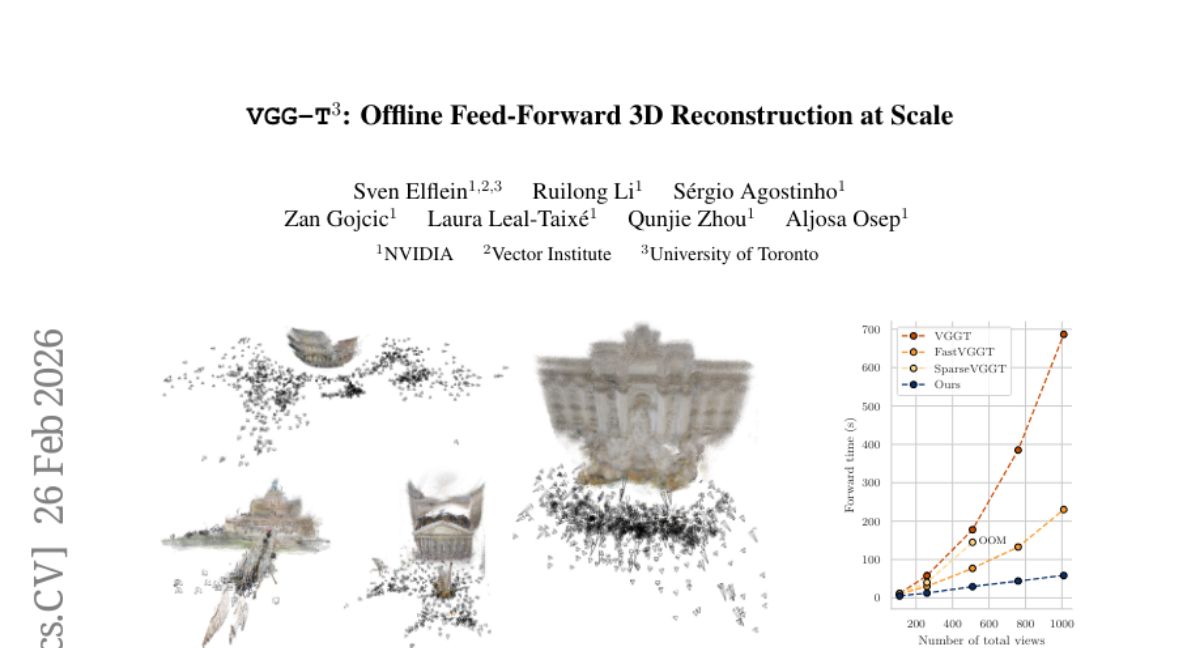
FastVGGT: Training-Free Acceleration of Visual Geometry Transformer
Foundation models for 3D vision have recently demonstrated remarkable capabilities in 3D perception. However, scaling these models to long-sequence image inputs remains a significant challenge due to inference-time inefficiency. In this work, we present a detailed analysis of VGGT, a state-of-the-art feed-forward visual geometry model and identify its primary bottleneck. Visualization further reveals a token collapse phenomenon in the attention maps. Motivated by these findings, we explore the potential of token merging in the feed-forward visual geometry model. Owing to the unique architectural and task-specific properties of 3D models, directly applying existing merging techniques proves challenging. To this end, we propose FastVGGT, which, for the first time, leverages token merging in the 3D domain through a training-free mechanism for accelerating VGGT. we devise a unique token partitioning strategy tailored to 3D architectures and tasks, effectively eliminating redundant computation while preserving VGGT's powerful reconstruction capacity. Extensive experiments on multiple 3D geometry benchmarks validate the effectiveness of our approach. Notably, with 1000 input images, FastVGGT achieves a 4x speedup over VGGT while mitigating error accumulation in long-sequence scenarios. These findings underscore the potential of token merging as a principled solution for scalable 3D vision systems. Code is available at: https://mystorm16.github.io/fastvggt/.
HOIGPT: Learning Long Sequence Hand-Object Interaction with Language Models
We introduce HOIGPT, a token-based generative method that unifies 3D hand-object interactions (HOI) perception and generation, offering the first comprehensive solution for captioning and generating high-quality 3D HOI sequences from a diverse range of conditional signals (\eg text, objects, partial sequences). At its core, HOIGPT utilizes a large language model to predict the bidrectional transformation between HOI sequences and natural language descriptions. Given text inputs, HOIGPT generates a sequence of hand and object meshes; given (partial) HOI sequences, HOIGPT generates text descriptions and completes the sequences. To facilitate HOI understanding with a large language model, this paper introduces two key innovations: (1) a novel physically grounded HOI tokenizer, the hand-object decomposed VQ-VAE, for discretizing HOI sequences, and (2) a motion-aware language model trained to process and generate both text and HOI tokens. Extensive experiments demonstrate that HOIGPT sets new state-of-the-art performance on both text generation (+2.01% R Precision) and HOI generation (-2.56 FID) across multiple tasks and benchmarks.
LongBench: A Bilingual, Multitask Benchmark for Long Context Understanding
Although large language models (LLMs) demonstrate impressive performance for many language tasks, most of them can only handle texts a few thousand tokens long, limiting their applications on longer sequence inputs, such as books, reports, and codebases. Recent works have proposed methods to improve LLMs' long context capabilities by extending context windows and more sophisticated memory mechanisms. However, comprehensive benchmarks tailored for evaluating long context understanding are lacking. In this paper, we introduce LongBench, the first bilingual, multi-task benchmark for long context understanding, enabling a more rigorous evaluation of long context understanding. LongBench comprises 21 datasets across 6 task categories in both English and Chinese, with an average length of 6,711 words (English) and 13,386 characters (Chinese). These tasks cover key long-text application areas including single-doc QA, multi-doc QA, summarization, few-shot learning, synthetic tasks, and code completion. All datasets in LongBench are standardized into a unified format, allowing for effortless automatic evaluation of LLMs. Upon comprehensive evaluation of 8 LLMs on LongBench, we find that: (1) Commercial model (GPT-3.5-Turbo-16k) outperforms other open-sourced models, but still struggles on longer contexts. (2) Scaled position embedding and fine-tuning on longer sequences lead to substantial improvement on long context understanding. (3) Context compression technique such as retrieval brings improvement for model with weak ability on long contexts, but the performance still lags behind models that have strong long context understanding capability. The code and datasets are available at https://github.com/THUDM/LongBench.
Out of Order: How Important Is The Sequential Order of Words in a Sentence in Natural Language Understanding Tasks?
Do state-of-the-art natural language understanding models care about word order - one of the most important characteristics of a sequence? Not always! We found 75% to 90% of the correct predictions of BERT-based classifiers, trained on many GLUE tasks, remain constant after input words are randomly shuffled. Despite BERT embeddings are famously contextual, the contribution of each individual word to downstream tasks is almost unchanged even after the word's context is shuffled. BERT-based models are able to exploit superficial cues (e.g. the sentiment of keywords in sentiment analysis; or the word-wise similarity between sequence-pair inputs in natural language inference) to make correct decisions when tokens are arranged in random orders. Encouraging classifiers to capture word order information improves the performance on most GLUE tasks, SQuAD 2.0 and out-of-samples. Our work suggests that many GLUE tasks are not challenging machines to understand the meaning of a sentence.
UniGist: Towards General and Hardware-aligned Sequence-level Long Context Compression
Large language models are increasingly capable of handling long-context inputs, but the memory overhead of key-value (KV) cache remains a major bottleneck for general-purpose deployment. While various compression strategies have been explored, sequence-level compression, which drops the full KV caches for certain tokens, is particularly challenging as it can lead to the loss of important contextual information. To address this, we introduce UniGist, a sequence-level long-context compression framework that efficiently preserves context information by replacing raw tokens with special compression tokens (gists) in a fine-grained manner. We adopt a chunk-free training strategy and design an efficient kernel with a gist shift trick, enabling optimized GPU training. Our scheme also supports flexible inference by allowing the actual removal of compressed tokens, resulting in real-time memory savings. Experiments across multiple long-context tasks demonstrate that UniGist significantly improves compression quality, with especially strong performance in detail-recalling tasks and long-range dependency modeling.
InternLM-XComposer2.5-OmniLive: A Comprehensive Multimodal System for Long-term Streaming Video and Audio Interactions
Creating AI systems that can interact with environments over long periods, similar to human cognition, has been a longstanding research goal. Recent advancements in multimodal large language models (MLLMs) have made significant strides in open-world understanding. However, the challenge of continuous and simultaneous streaming perception, memory, and reasoning remains largely unexplored. Current MLLMs are constrained by their sequence-to-sequence architecture, which limits their ability to process inputs and generate responses simultaneously, akin to being unable to think while perceiving. Furthermore, relying on long contexts to store historical data is impractical for long-term interactions, as retaining all information becomes costly and inefficient. Therefore, rather than relying on a single foundation model to perform all functions, this project draws inspiration from the concept of the Specialized Generalist AI and introduces disentangled streaming perception, reasoning, and memory mechanisms, enabling real-time interaction with streaming video and audio input. The proposed framework InternLM-XComposer2.5-OmniLive (IXC2.5-OL) consists of three key modules: (1) Streaming Perception Module: Processes multimodal information in real-time, storing key details in memory and triggering reasoning in response to user queries. (2) Multi-modal Long Memory Module: Integrates short-term and long-term memory, compressing short-term memories into long-term ones for efficient retrieval and improved accuracy. (3) Reasoning Module: Responds to queries and executes reasoning tasks, coordinating with the perception and memory modules. This project simulates human-like cognition, enabling multimodal large language models to provide continuous and adaptive service over time.
Efficient Long-Range Transformers: You Need to Attend More, but Not Necessarily at Every Layer
Pretrained transformer models have demonstrated remarkable performance across various natural language processing tasks. These models leverage the attention mechanism to capture long- and short-range dependencies in the sequence. However, the (full) attention mechanism incurs high computational cost - quadratic in the sequence length, which is not affordable in tasks with long sequences, e.g., inputs with 8k tokens. Although sparse attention can be used to improve computational efficiency, as suggested in existing work, it has limited modeling capacity and often fails to capture complicated dependencies in long sequences. To tackle this challenge, we propose MASFormer, an easy-to-implement transformer variant with Mixed Attention Spans. Specifically, MASFormer is equipped with full attention to capture long-range dependencies, but only at a small number of layers. For the remaining layers, MASformer only employs sparse attention to capture short-range dependencies. Our experiments on natural language modeling and generation tasks show that a decoder-only MASFormer model of 1.3B parameters can achieve competitive performance to vanilla transformers with full attention while significantly reducing computational cost (up to 75%). Additionally, we investigate the effectiveness of continual training with long sequence data and how sequence length impacts downstream generation performance, which may be of independent interest.
Functional Interpolation for Relative Positions Improves Long Context Transformers
Preventing the performance decay of Transformers on inputs longer than those used for training has been an important challenge in extending the context length of these models. Though the Transformer architecture has fundamentally no limits on the input sequence lengths it can process, the choice of position encoding used during training can limit the performance of these models on longer inputs. We propose a novel functional relative position encoding with progressive interpolation, FIRE, to improve Transformer generalization to longer contexts. We theoretically prove that this can represent some of the popular relative position encodings, such as T5's RPE, Alibi, and Kerple. We next empirically show that FIRE models have better generalization to longer contexts on both zero-shot language modeling and long text benchmarks.
InfLLM-V2: Dense-Sparse Switchable Attention for Seamless Short-to-Long Adaptation
Long-sequence processing is a critical capability for modern large language models. However, the self-attention mechanism in the standard Transformer architecture faces severe computational and memory bottlenecks when processing long sequences. While trainable sparse attention methods offer a promising solution, existing approaches such as NSA introduce excessive extra parameters and disrupt the conventional pretrain-on-short, finetune-on-long workflow, resulting in slow convergence and difficulty in acceleration. To overcome these limitations, we introduce dense-sparse switchable attention framework, termed as InfLLM-V2. InfLLM-V2 is a trainable sparse attention that seamlessly adapts models from short to long sequences. Specifically, InfLLM-V2 reuses dense attention parameters through parameter-free architecture modification, maintaining consistency between short and long sequence processing. Additionally, InfLLM-V2 ensures computational efficiency across all sequence lengths, by using dense attention for short inputs and smoothly transitioning to sparse attention for long sequences. To achieve practical acceleration, we further introduce an efficient implementation of InfLLM-V2 that significantly reduces the computational overhead. Our experiments on long-context understanding and chain-of-thought reasoning demonstrate that InfLLM-V2 is 4times faster than dense attention while retaining 98.1% and 99.7% of the performance, respectively. Based on the InfLLM-V2 framework, we have trained and open-sourced MiniCPM4.1 (https://huggingface.co/openbmb/MiniCPM4.1-8B), a hybrid reasoning model, providing a reproducible implementation for the research community.
KV Cache Compression, But What Must We Give in Return? A Comprehensive Benchmark of Long Context Capable Approaches
Long context capability is a crucial competency for large language models (LLMs) as it mitigates the human struggle to digest long-form texts. This capability enables complex task-solving scenarios such as book summarization, code assistance, and many more tasks that are traditionally manpower-intensive. However, transformer-based LLMs face significant challenges with long context input due to the growing size of the KV cache and the intrinsic complexity of attending to extended inputs; where multiple schools of efficiency-driven approaches -- such as KV cache quantization, token dropping, prompt compression, linear-time sequence models, and hybrid architectures -- have been proposed to produce efficient yet long context-capable models. Despite these advancements, no existing work has comprehensively benchmarked these methods in a reasonably aligned environment. In this work, we fill this gap by providing a taxonomy of current methods and evaluating 10+ state-of-the-art approaches across seven categories of long context tasks. Our work reveals numerous previously unknown phenomena and offers insights -- as well as a friendly workbench -- for the future development of long context-capable LLMs. The source code will be available at https://github.com/henryzhongsc/longctx_bench
DVGT: Driving Visual Geometry Transformer
Perceiving and reconstructing 3D scene geometry from visual inputs is crucial for autonomous driving. However, there still lacks a driving-targeted dense geometry perception model that can adapt to different scenarios and camera configurations. To bridge this gap, we propose a Driving Visual Geometry Transformer (DVGT), which reconstructs a global dense 3D point map from a sequence of unposed multi-view visual inputs. We first extract visual features for each image using a DINO backbone, and employ alternating intra-view local attention, cross-view spatial attention, and cross-frame temporal attention to infer geometric relations across images. We then use multiple heads to decode a global point map in the ego coordinate of the first frame and the ego poses for each frame. Unlike conventional methods that rely on precise camera parameters, DVGT is free of explicit 3D geometric priors, enabling flexible processing of arbitrary camera configurations. DVGT directly predicts metric-scaled geometry from image sequences, eliminating the need for post-alignment with external sensors. Trained on a large mixture of driving datasets including nuScenes, OpenScene, Waymo, KITTI, and DDAD, DVGT significantly outperforms existing models on various scenarios. Code is available at https://github.com/wzzheng/DVGT.
Greenformers: Improving Computation and Memory Efficiency in Transformer Models via Low-Rank Approximation
In this thesis, we introduce Greenformers, a collection of model efficiency methods to improve the model efficiency of the recently renowned transformer models with a low-rank approximation approach. The development trend of deep learning models tends to results in a more complex and larger model. Although it leads to a better and more accurate prediction, the resulting model becomes even more costly, as it requires weeks of training with a huge amount of GPU resources. Particularly, the size and computational cost of transformer-based models have increased tremendously since its first debut in 2017 from ~100 million parameters up to ~1.6 trillion parameters in early 2021. This computationally hungry model also incurs a substantial cost to the environment and even reaches an alarming level of carbon footprint. Some of these models are so massive that it is even impossible to run the model without a GPU cluster. Greenformers improve the model efficiency of transformer models by applying low-rank approximation approaches. Specifically, we propose a low-rank factorization approach to improve the efficiency of the transformer model called Low-Rank Transformer. We further compare our model with an existing low-rank factorization approach called Linformer. Based on our analysis, the Low-Rank Transformer model is suitable for improving both the time and memory efficiency in processing short-sequence (<= 512) input data, while the Linformer model is suitable for improving the efficiency in processing long-sequence input data (>= 512). We also show that Low-Rank Transformer is more suitable for on-device deployment, as it significantly reduces the model size. Additionally, we estimate that applying LRT to the existing BERT-base model can significantly reduce the computational, economical, and environmental costs for developing such models by more than 30% of its original costs.
EE-MLLM: A Data-Efficient and Compute-Efficient Multimodal Large Language Model
In the realm of multimodal research, numerous studies leverage substantial image-text pairs to conduct modal alignment learning, transforming Large Language Models (LLMs) into Multimodal LLMs and excelling in a variety of visual-language tasks. The prevailing methodologies primarily fall into two categories: self-attention-based and cross-attention-based methods. While self-attention-based methods offer superior data efficiency due to their simple MLP architecture, they often suffer from lower computational efficiency due to concatenating visual and textual tokens as input for LLM. Conversely, cross-attention-based methods, although less data-efficient due to additional learnable parameters, exhibit higher computational efficiency by avoiding long sequence input for LLM. To address these trade-offs, we introduce the Data-Efficient and Compute-Efficient Multimodal Large Language Model (EE-MLLM). Without introducing additional modules or learnable parameters, EE-MLLM achieves both data and compute efficiency. Specifically, we modify the original self-attention mechanism in MLLM to a composite attention mechanism. This mechanism has two key characteristics: 1) Eliminating the computational overhead of self-attention within visual tokens to achieve compute efficiency, and 2) Reusing the weights on each layer of LLM to facilitate effective modality alignment between vision and language for data efficiency. Experimental results demonstrate the effectiveness of EE-MLLM across a range of benchmarks, including general-purpose datasets like MMBench and SeedBench, as well as fine-grained tasks such as TextVQA and DocVQA.
Sequence Parallelism: Long Sequence Training from System Perspective
Transformer achieves promising results on various tasks. However, self-attention suffers from quadratic memory requirements with respect to the sequence length. Existing work focuses on reducing time and space complexity from an algorithm perspective. In this work, we propose sequence parallelism, a memory-efficient parallelism method to help us break input sequence length limitation and train with longer sequences on GPUs efficiently. Our approach is compatible with most existing parallelisms (e.g. data parallelism, pipeline parallelism and tensor parallelism), which means our sequence parallelism makes 4D parallelism possible. More importantly, we no longer require a single device to hold the whole sequence. That is, with sparse attention, our sequence parallelism enables us to train transformer with infinite long sequence. Specifically, we split the input sequence into multiple chunks and feed each chunk into its corresponding device (i.e. GPU). To compute the attention output, we integrated ring-style communication with self-attention calculation and proposed Ring Self-Attention (RSA). Experiments show that sequence parallelism performs well when scaling with batch size and sequence length. Compared with tensor parallelism, our approach achieved 13.7times and 3.0times maximum batch size and sequence length respectively when scaling up to 64 NVIDIA P100 GPUs. With sparse attention, sequence can handle sequence with over 114K tokens, which is over 27times longer than existing sparse attention works holding the whole sequence on a single device.
Long-LRM: Long-sequence Large Reconstruction Model for Wide-coverage Gaussian Splats
We propose Long-LRM, a generalizable 3D Gaussian reconstruction model that is capable of reconstructing a large scene from a long sequence of input images. Specifically, our model can process 32 source images at 960x540 resolution within only 1.3 seconds on a single A100 80G GPU. Our architecture features a mixture of the recent Mamba2 blocks and the classical transformer blocks which allowed many more tokens to be processed than prior work, enhanced by efficient token merging and Gaussian pruning steps that balance between quality and efficiency. Unlike previous feed-forward models that are limited to processing 1~4 input images and can only reconstruct a small portion of a large scene, Long-LRM reconstructs the entire scene in a single feed-forward step. On large-scale scene datasets such as DL3DV-140 and Tanks and Temples, our method achieves performance comparable to optimization-based approaches while being two orders of magnitude more efficient. Project page: https://arthurhero.github.io/projects/llrm
What Makes Convolutional Models Great on Long Sequence Modeling?
Convolutional models have been widely used in multiple domains. However, most existing models only use local convolution, making the model unable to handle long-range dependency efficiently. Attention overcomes this problem by aggregating global information but also makes the computational complexity quadratic to the sequence length. Recently, Gu et al. [2021] proposed a model called S4 inspired by the state space model. S4 can be efficiently implemented as a global convolutional model whose kernel size equals the input sequence length. S4 can model much longer sequences than Transformers and achieve significant gains over SoTA on several long-range tasks. Despite its empirical success, S4 is involved. It requires sophisticated parameterization and initialization schemes. As a result, S4 is less intuitive and hard to use. Here we aim to demystify S4 and extract basic principles that contribute to the success of S4 as a global convolutional model. We focus on the structure of the convolution kernel and identify two critical but intuitive principles enjoyed by S4 that are sufficient to make up an effective global convolutional model: 1) The parameterization of the convolutional kernel needs to be efficient in the sense that the number of parameters should scale sub-linearly with sequence length. 2) The kernel needs to satisfy a decaying structure that the weights for convolving with closer neighbors are larger than the more distant ones. Based on the two principles, we propose a simple yet effective convolutional model called Structured Global Convolution (SGConv). SGConv exhibits strong empirical performance over several tasks: 1) With faster speed, SGConv surpasses S4 on Long Range Arena and Speech Command datasets. 2) When plugging SGConv into standard language and vision models, it shows the potential to improve both efficiency and performance.
SPPO:Efficient Long-sequence LLM Training via Adaptive Sequence Pipeline Parallel Offloading
In recent years, Large Language Models (LLMs) have exhibited remarkable capabilities, driving advancements in real-world applications. However, training LLMs on increasingly long input sequences imposes significant challenges due to high GPU memory and computational demands. Existing solutions face two key limitations: (1) memory reduction techniques, such as activation recomputation and CPU offloading, compromise training efficiency; (2) distributed parallelism strategies require excessive GPU resources, limiting the scalability of input sequence length. To address these gaps, we propose Adaptive Sequence Pipeline Parallel Offloading (SPPO), a novel LLM training framework that optimizes memory and computational resource efficiency for long-sequence training. SPPO introduces adaptive offloading, leveraging sequence-aware offloading, and two-level activation management to reduce GPU memory consumption without degrading the training efficiency. Additionally, SPPO develops an adaptive pipeline scheduling approach with a heuristic solver and multiplexed sequence partitioning to improve computational resource efficiency. Experimental results demonstrate that SPPO achieves up to 3.38x throughput improvement over Megatron-LM and DeepSpeed, realizing efficient training of a 7B LLM with sequence lengths of up to 4M tokens on only 128 A100 GPUs.
Recycled Attention: Efficient inference for long-context language models
Generating long sequences of tokens given a long-context input imposes a heavy computational burden for large language models (LLMs). One of the computational bottleneck comes from computing attention over a long sequence of input at each generation step. In this paper, we propose Recycled Attention, an inference-time method which alternates between full context attention and attention over a subset of input tokens. When performing partial attention, we recycle the attention pattern of a previous token that has performed full attention and attend only to the top K most attended tokens, reducing the cost of data movement and attention computation. Compared to previously proposed inference-time acceleration method which attends only to local context or tokens with high accumulative attention scores, our approach flexibly chooses tokens that are relevant to the current decoding step. We evaluate our methods on RULER, a suite of tasks designed to comprehensively evaluate long-context abilities, and long-context language modeling tasks. Applying our method to off-the-shelf LLMs achieves comparable speedup to baselines which only consider local context while improving the performance by 2x. We further explore two ideas to improve performance-efficiency trade-offs: (1) dynamically decide when to perform recycled or full attention step based on the query similarities and (2) continued pre-training the model with Recycled Attention.
SpanDrop: Simple and Effective Counterfactual Learning for Long Sequences
Distilling supervision signal from a long sequence to make predictions is a challenging task in machine learning, especially when not all elements in the input sequence contribute equally to the desired output. In this paper, we propose SpanDrop, a simple and effective data augmentation technique that helps models identify the true supervision signal in a long sequence with very few examples. By directly manipulating the input sequence, SpanDrop randomly ablates parts of the sequence at a time and ask the model to perform the same task to emulate counterfactual learning and achieve input attribution. Based on theoretical analysis of its properties, we also propose a variant of SpanDrop based on the beta-Bernoulli distribution, which yields diverse augmented sequences while providing a learning objective that is more consistent with the original dataset. We demonstrate the effectiveness of SpanDrop on a set of carefully designed toy tasks, as well as various natural language processing tasks that require reasoning over long sequences to arrive at the correct answer, and show that it helps models improve performance both when data is scarce and abundant.
Beyond the Limits: A Survey of Techniques to Extend the Context Length in Large Language Models
Recently, large language models (LLMs) have shown remarkable capabilities including understanding context, engaging in logical reasoning, and generating responses. However, this is achieved at the expense of stringent computational and memory requirements, hindering their ability to effectively support long input sequences. This survey provides an inclusive review of the recent techniques and methods devised to extend the sequence length in LLMs, thereby enhancing their capacity for long-context understanding. In particular, we review and categorize a wide range of techniques including architectural modifications, such as modified positional encoding and altered attention mechanisms, which are designed to enhance the processing of longer sequences while avoiding a proportional increase in computational requirements. The diverse methodologies investigated in this study can be leveraged across different phases of LLMs, i.e., training, fine-tuning and inference. This enables LLMs to efficiently process extended sequences. The limitations of the current methodologies is discussed in the last section along with the suggestions for future research directions, underscoring the importance of sequence length in the continued advancement of LLMs.
Extending Input Contexts of Language Models through Training on Segmented Sequences
Effectively training language models on long inputs poses many technical challenges. As a cost consideration, languages models are pretrained on a fixed sequence length before being adapted to longer sequences. We explore various methods for adapting models to longer inputs by training on segmented sequences and an interpolation-based method for extending absolute positional embeddings. We develop a training procedure to extend the input context size of pretrained models with no architectural changes and no additional memory costs than training on the original input lengths. By sub-sampling segments from long inputs while maintaining their original position the model is able to learn new positional interactions. Our method benefits both models trained with absolute positional embeddings, by extending their input contexts, as well as popular relative positional embedding methods showing a reduced perplexity on sequences longer than they were trained on. We demonstrate our method can extend input contexts by a factor of 4x while improving perplexity.
LLMtimesMapReduce-V2: Entropy-Driven Convolutional Test-Time Scaling for Generating Long-Form Articles from Extremely Long Resources
Long-form generation is crucial for a wide range of practical applications, typically categorized into short-to-long and long-to-long generation. While short-to-long generations have received considerable attention, generating long texts from extremely long resources remains relatively underexplored. The primary challenge in long-to-long generation lies in effectively integrating and analyzing relevant information from extensive inputs, which remains difficult for current large language models (LLMs). In this paper, we propose LLMtimesMapReduce-V2, a novel test-time scaling strategy designed to enhance the ability of LLMs to process extremely long inputs. Drawing inspiration from convolutional neural networks, which iteratively integrate local features into higher-level global representations, LLMtimesMapReduce-V2 utilizes stacked convolutional scaling layers to progressively expand the understanding of input materials. Both quantitative and qualitative experimental results demonstrate that our approach substantially enhances the ability of LLMs to process long inputs and generate coherent, informative long-form articles, outperforming several representative baselines.
Longformer: The Long-Document Transformer
Transformer-based models are unable to process long sequences due to their self-attention operation, which scales quadratically with the sequence length. To address this limitation, we introduce the Longformer with an attention mechanism that scales linearly with sequence length, making it easy to process documents of thousands of tokens or longer. Longformer's attention mechanism is a drop-in replacement for the standard self-attention and combines a local windowed attention with a task motivated global attention. Following prior work on long-sequence transformers, we evaluate Longformer on character-level language modeling and achieve state-of-the-art results on text8 and enwik8. In contrast to most prior work, we also pretrain Longformer and finetune it on a variety of downstream tasks. Our pretrained Longformer consistently outperforms RoBERTa on long document tasks and sets new state-of-the-art results on WikiHop and TriviaQA. We finally introduce the Longformer-Encoder-Decoder (LED), a Longformer variant for supporting long document generative sequence-to-sequence tasks, and demonstrate its effectiveness on the arXiv summarization dataset.
CoLT5: Faster Long-Range Transformers with Conditional Computation
Many natural language processing tasks benefit from long inputs, but processing long documents with Transformers is expensive -- not only due to quadratic attention complexity but also from applying feedforward and projection layers to every token. However, not all tokens are equally important, especially for longer documents. We propose CoLT5, a long-input Transformer model that builds on this intuition by employing conditional computation, devoting more resources to important tokens in both feedforward and attention layers. We show that CoLT5 achieves stronger performance than LongT5 with much faster training and inference, achieving SOTA on the long-input SCROLLS benchmark. Moreover, CoLT5 can effectively and tractably make use of extremely long inputs, showing strong gains up to 64k input length.
Squeezed Attention: Accelerating Long Context Length LLM Inference
Emerging Large Language Model (LLM) applications require long input prompts to perform complex downstream tasks like document analysis and code generation. For these long context length applications, the length of the input prompt poses a significant challenge in terms of inference efficiency since the inference costs increase linearly with sequence length. However, for many of these applications, much of the context in the prompt is fixed across different user inputs, thereby providing the opportunity to perform offline optimizations to process user inputs quickly, as they are received. In this work, we propose Squeezed Attention as a mechanism to accelerate LLM applications where a large portion of the input prompt is fixed. We first leverage K-means clustering offline to group the keys for the fixed context based on semantic similarity and represent each cluster with a single centroid value. During inference, we compare query tokens from the user input with the centroids to predict which of the keys from the fixed context are semantically relevant and need to be loaded during inference. We then compute exact attention using only these important keys from the fixed context, thereby reducing bandwidth and computational costs. We also extend our method to use a hierarchical centroid lookup to identify important keys, which can reduce the complexity of attention from linear to logarithmic with respect to the context length. We implement optimized Triton kernels for centroid comparison and sparse FlashAttention with important keys, achieving more than 4x speedups during both the prefill and generation phases for long-context inference. Furthermore, we have extensively evaluated our method on various long-context benchmarks including LongBench, where it achieves a 3x reduction in KV cache budget without accuracy loss and up to an 8x reduction with <0.5 point accuracy gap for various models.
LM-Infinite: Simple On-the-Fly Length Generalization for Large Language Models
In recent years, there have been remarkable advancements in the performance of Transformer-based Large Language Models (LLMs) across various domains. As these LLMs are deployed for increasingly complex tasks, they often face the needs to conduct longer reasoning processes or understanding larger contexts. In these situations, the length generalization failure of LLMs on long sequences become more prominent. Most pre-training schemes truncate training sequences to a fixed length (such as 2048 for LLaMa). LLMs often struggle to generate fluent texts, let alone carry out downstream tasks, after longer contexts, even with relative positional encoding which is designed to cope with this problem. Common solutions such as finetuning on longer corpora often involves daunting hardware and time costs and requires careful training process design. To more efficiently leverage the generation capacity of existing LLMs, we theoretically and empirically investigate the main out-of-distribution (OOD) factors contributing to this problem. Inspired by this diagnosis, we propose a simple yet effective solution for on-the-fly length generalization, LM-Infinite, which involves only a Lambda-shaped attention mask and a distance limit while requiring no parameter updates or learning. We find it applicable to a variety of LLMs using relative-position encoding methods. LM-Infinite is computational efficient with O(n) time and space, and demonstrates consistent fluency and generation quality to as long as 32k tokens on ArXiv and OpenWebText2 datasets, with 2.72x decoding speedup. On downstream task such as passkey retrieval, it continues to work on inputs much longer than training lengths where vanilla models fail immediately.
Sequence Transduction with Recurrent Neural Networks
Many machine learning tasks can be expressed as the transformation---or transduction---of input sequences into output sequences: speech recognition, machine translation, protein secondary structure prediction and text-to-speech to name but a few. One of the key challenges in sequence transduction is learning to represent both the input and output sequences in a way that is invariant to sequential distortions such as shrinking, stretching and translating. Recurrent neural networks (RNNs) are a powerful sequence learning architecture that has proven capable of learning such representations. However RNNs traditionally require a pre-defined alignment between the input and output sequences to perform transduction. This is a severe limitation since finding the alignment is the most difficult aspect of many sequence transduction problems. Indeed, even determining the length of the output sequence is often challenging. This paper introduces an end-to-end, probabilistic sequence transduction system, based entirely on RNNs, that is in principle able to transform any input sequence into any finite, discrete output sequence. Experimental results for phoneme recognition are provided on the TIMIT speech corpus.
LongBoX: Evaluating Transformers on Long-Sequence Clinical Tasks
Many large language models (LLMs) for medicine have largely been evaluated on short texts, and their ability to handle longer sequences such as a complete electronic health record (EHR) has not been systematically explored. Assessing these models on long sequences is crucial since prior work in the general domain has demonstrated performance degradation of LLMs on longer texts. Motivated by this, we introduce LongBoX, a collection of seven medical datasets in text-to-text format, designed to investigate model performance on long sequences. Preliminary experiments reveal that both medical LLMs (e.g., BioGPT) and strong general domain LLMs (e.g., FLAN-T5) struggle on this benchmark. We further evaluate two techniques designed for long-sequence handling: (i) local-global attention, and (ii) Fusion-in-Decoder (FiD). Our results demonstrate mixed results with long-sequence handling - while scores on some datasets increase, there is substantial room for improvement. We hope that LongBoX facilitates the development of more effective long-sequence techniques for the medical domain. Data and source code are available at https://github.com/Mihir3009/LongBoX.
LCIRC: A Recurrent Compression Approach for Efficient Long-form Context and Query Dependent Modeling in LLMs
While large language models (LLMs) excel in generating coherent and contextually rich outputs, their capacity to efficiently handle long-form contexts is limited by fixed-length position embeddings. Additionally, the computational cost of processing long sequences increases quadratically, making it challenging to extend context length. To address these challenges, we propose Long-form Context Injection with Recurrent Compression (LCIRC), a method that enables the efficient processing long-form sequences beyond the model's length limit through recurrent compression without retraining the entire model. We further introduce query dependent context modeling, which selectively compresses query-relevant information, ensuring that the model retains the most pertinent content. Our empirical results demonstrate that Query Dependent LCIRC (QD-LCIRC) significantly improves LLM's ability to manage extended contexts, making it well-suited for tasks that require both comprehensive context understanding and query relevance.
Do Long-Range Language Models Actually Use Long-Range Context?
Language models are generally trained on short, truncated input sequences, which limits their ability to use discourse-level information present in long-range context to improve their predictions. Recent efforts to improve the efficiency of self-attention have led to a proliferation of long-range Transformer language models, which can process much longer sequences than models of the past. However, the ways in which such models take advantage of the long-range context remain unclear. In this paper, we perform a fine-grained analysis of two long-range Transformer language models (including the Routing Transformer, which achieves state-of-the-art perplexity on the PG-19 long-sequence LM benchmark dataset) that accept input sequences of up to 8K tokens. Our results reveal that providing long-range context (i.e., beyond the previous 2K tokens) to these models only improves their predictions on a small set of tokens (e.g., those that can be copied from the distant context) and does not help at all for sentence-level prediction tasks. Finally, we discover that PG-19 contains a variety of different document types and domains, and that long-range context helps most for literary novels (as opposed to textbooks or magazines).
InfLLM: Unveiling the Intrinsic Capacity of LLMs for Understanding Extremely Long Sequences with Training-Free Memory
Large language models (LLMs) have emerged as a cornerstone in real-world applications with lengthy streaming inputs, such as LLM-driven agents. However, existing LLMs, pre-trained on sequences with restricted maximum length, cannot generalize to longer sequences due to the out-of-domain and distraction issues. To alleviate these issues, existing efforts employ sliding attention windows and discard distant tokens to achieve the processing of extremely long sequences. Unfortunately, these approaches inevitably fail to capture long-distance dependencies within sequences to deeply understand semantics. This paper introduces a training-free memory-based method, InfLLM, to unveil the intrinsic ability of LLMs to process streaming long sequences. Specifically, InfLLM stores distant contexts into additional memory units and employs an efficient mechanism to lookup token-relevant units for attention computation. Thereby, InfLLM allows LLMs to efficiently process long sequences while maintaining the ability to capture long-distance dependencies. Without any training, InfLLM enables LLMs pre-trained on sequences of a few thousand tokens to achieve superior performance than competitive baselines continually training these LLMs on long sequences. Even when the sequence length is scaled to 1,024K, InfLLM still effectively captures long-distance dependencies.
Giraffe: Adventures in Expanding Context Lengths in LLMs
Modern large language models (LLMs) that rely on attention mechanisms are typically trained with fixed context lengths which enforce upper limits on the length of input sequences that they can handle at evaluation time. To use these models on sequences longer than the train-time context length, one might employ techniques from the growing family of context length extrapolation methods -- most of which focus on modifying the system of positional encodings used in the attention mechanism to indicate where tokens or activations are located in the input sequence. We conduct a wide survey of existing methods of context length extrapolation on a base LLaMA or LLaMA 2 model, and introduce some of our own design as well -- in particular, a new truncation strategy for modifying the basis for the position encoding. We test these methods using three new evaluation tasks (FreeFormQA, AlteredNumericQA, and LongChat-Lines) as well as perplexity, which we find to be less fine-grained as a measure of long context performance of LLMs. We release the three tasks publicly as datasets on HuggingFace. We discover that linear scaling is the best method for extending context length, and show that further gains can be achieved by using longer scales at evaluation time. We also discover promising extrapolation capabilities in the truncated basis. To support further research in this area, we release three new 13B parameter long-context models which we call Giraffe: 4k and 16k context models trained from base LLaMA-13B, and a 32k context model trained from base LLaMA2-13B. We also release the code to replicate our results.
Extending Memory for Language Modelling
Breakthroughs in deep learning and memory networks have made major advances in natural language understanding. Language is sequential and information carried through the sequence can be captured through memory networks. Learning the sequence is one of the key aspects in learning the language. However, memory networks are not capable of holding infinitely long sequences in their memories and are limited by various constraints such as the vanishing or exploding gradient problem. Therefore, natural language understanding models are affected when presented with long sequential text. We introduce Long Term Memory network (LTM) to learn from infinitely long sequences. LTM gives priority to the current inputs to allow it to have a high impact. Language modeling is an important factor in natural language understanding. LTM was tested in language modeling, which requires long term memory. LTM is tested on Penn Tree bank dataset, Google Billion Word dataset and WikiText-2 dataset. We compare LTM with other language models which require long term memory.
A Multilingual Translator to SQL with Database Schema Pruning to Improve Self-Attention
Long sequences of text are challenging in the context of transformers, due to quadratic memory increase in the self-attention mechanism. As this issue directly affects the translation from natural language to SQL queries (as techniques usually take as input a concatenated text with the question and the database schema), we present techniques that allow long text sequences to be handled by transformers with up to 512 input tokens. We propose a training process with database schema pruning (removal of tables and columns names that are useless for the query of interest). In addition, we used a multilingual approach with the mT5-large model fine-tuned with a data-augmented Spider dataset in four languages simultaneously: English, Portuguese, Spanish, and French. Our proposed technique used the Spider dataset and increased the exact set match accuracy results from 0.718 to 0.736 in a validation dataset (Dev). Source code, evaluations, and checkpoints are available at: https://github.com/C4AI/gap-text2sql.
DeciMamba: Exploring the Length Extrapolation Potential of Mamba
Long-range sequence processing poses a significant challenge for Transformers due to their quadratic complexity in input length. A promising alternative is Mamba, which demonstrates high performance and achieves Transformer-level capabilities while requiring substantially fewer computational resources. In this paper we explore the length-generalization capabilities of Mamba, which we find to be relatively limited. Through a series of visualizations and analyses we identify that the limitations arise from a restricted effective receptive field, dictated by the sequence length used during training. To address this constraint, we introduce DeciMamba, a context-extension method specifically designed for Mamba. This mechanism, built on top of a hidden filtering mechanism embedded within the S6 layer, enables the trained model to extrapolate well even without additional training. Empirical experiments over real-world long-range NLP tasks show that DeciMamba can extrapolate to context lengths that are 25x times longer than the ones seen during training, and does so without utilizing additional computational resources. We will release our code and models.
Benchmarking Sequential Visual Input Reasoning and Prediction in Multimodal Large Language Models
Multimodal large language models (MLLMs) have shown great potential in perception and interpretation tasks, but their capabilities in predictive reasoning remain under-explored. To address this gap, we introduce a novel benchmark that assesses the predictive reasoning capabilities of MLLMs across diverse scenarios. Our benchmark targets three important domains: abstract pattern reasoning, human activity prediction, and physical interaction prediction. We further develop three evaluation methods powered by large language model to robustly quantify a model's performance in predicting and reasoning the future based on multi-visual context. Empirical experiments confirm the soundness of the proposed benchmark and evaluation methods via rigorous testing and reveal pros and cons of current popular MLLMs in the task of predictive reasoning. Lastly, our proposed benchmark provides a standardized evaluation framework for MLLMs and can facilitate the development of more advanced models that can reason and predict over complex long sequence of multimodal input.
Dataset Decomposition: Faster LLM Training with Variable Sequence Length Curriculum
Large language models (LLMs) are commonly trained on datasets consisting of fixed-length token sequences. These datasets are created by randomly concatenating documents of various lengths and then chunking them into sequences of a predetermined target length. However, this method of concatenation can lead to cross-document attention within a sequence, which is neither a desirable learning signal nor computationally efficient. Additionally, training on long sequences becomes computationally prohibitive due to the quadratic cost of attention. In this study, we introduce dataset decomposition, a novel variable sequence length training technique, to tackle these challenges. We decompose a dataset into a union of buckets, each containing sequences of the same size extracted from a unique document. During training, we use variable sequence length and batch size, sampling simultaneously from all buckets with a curriculum. In contrast to the concat-and-chunk baseline, which incurs a fixed attention cost at every step of training, our proposed method incurs a penalty proportional to the actual document lengths at each step, resulting in significant savings in training time. We train an 8k context-length 1B model at the same cost as a 2k context-length model trained with the baseline approach. Experiments on a web-scale corpus demonstrate that our approach significantly enhances performance on standard language evaluations and long-context benchmarks, reaching target accuracy 3x faster compared to the baseline. Our method not only enables efficient pretraining on long sequences but also scales effectively with dataset size. Lastly, we shed light on a critical yet less studied aspect of training large language models: the distribution and curriculum of sequence lengths, which results in a non-negligible difference in performance.
Long-context LLMs Struggle with Long In-context Learning
Large Language Models (LLMs) have made significant strides in handling long sequences exceeding 32K tokens. However, their performance evaluation has largely been confined to metrics like perplexity and synthetic tasks, which may not fully capture their abilities in more nuanced, real-world scenarios. This study introduces a specialized benchmark (LIConBench) focusing on long in-context learning within the realm of extreme-label classification. We meticulously selected six datasets with a label range spanning 28 to 174 classes covering different input (few-shot demonstration) length from 2K to 50K. Our benchmark requires LLMs to comprehend the entire input to recognize the massive label spaces to make correct prediction. We evaluate 13 long-context LLMs on our benchmarks. We find that the long-context LLMs perform relatively well under the token length of 20K and the performance benefits from utilizing the long context window. However, after the context window exceeds 20K, most LLMs except GPT-4 will dip dramatically. This suggests a notable gap in current LLM capabilities for processing and understanding long, context-rich sequences. Further analysis revealed a tendency among models to favor predictions for labels presented towards the end at the sequence. Their ability to reason over multiple pieces in the long sequence is yet to be improved. Our study reveals that long context understanding and reasoning is still a challenging task for the existing LLMs. We believe LIConBench could serve as a more realistic evaluation for the future long context LLMs.
LongAlign: A Recipe for Long Context Alignment of Large Language Models
Extending large language models to effectively handle long contexts requires instruction fine-tuning on input sequences of similar length. To address this, we present LongAlign -- a recipe of the instruction data, training, and evaluation for long context alignment. First, we construct a long instruction-following dataset using Self-Instruct. To ensure the data diversity, it covers a broad range of tasks from various long context sources. Second, we adopt the packing and sorted batching strategies to speed up supervised fine-tuning on data with varied length distributions. Additionally, we develop a loss weighting method to balance the contribution to the loss across different sequences during packing training. Third, we introduce the LongBench-Chat benchmark for evaluating instruction-following capabilities on queries of 10k-100k in length. Experiments show that LongAlign outperforms existing recipes for LLMs in long context tasks by up to 30\%, while also maintaining their proficiency in handling short, generic tasks. The code, data, and long-aligned models are open-sourced at https://github.com/THUDM/LongAlign.
LongNet: Scaling Transformers to 1,000,000,000 Tokens
Scaling sequence length has become a critical demand in the era of large language models. However, existing methods struggle with either computational complexity or model expressivity, rendering the maximum sequence length restricted. In this work, we introduce LongNet, a Transformer variant that can scale sequence length to more than 1 billion tokens, without sacrificing the performance on shorter sequences. Specifically, we propose dilated attention, which expands the attentive field exponentially as the distance grows. LongNet has significant advantages: 1) it has a linear computation complexity and a logarithm dependency between tokens; 2) it can be served as a distributed trainer for extremely long sequences; 3) its dilated attention is a drop-in replacement for standard attention, which can be seamlessly integrated with the existing Transformer-based optimization. Experiments results demonstrate that LongNet yields strong performance on both long-sequence modeling and general language tasks. Our work opens up new possibilities for modeling very long sequences, e.g., treating a whole corpus or even the entire Internet as a sequence.
Deconvolutional Paragraph Representation Learning
Learning latent representations from long text sequences is an important first step in many natural language processing applications. Recurrent Neural Networks (RNNs) have become a cornerstone for this challenging task. However, the quality of sentences during RNN-based decoding (reconstruction) decreases with the length of the text. We propose a sequence-to-sequence, purely convolutional and deconvolutional autoencoding framework that is free of the above issue, while also being computationally efficient. The proposed method is simple, easy to implement and can be leveraged as a building block for many applications. We show empirically that compared to RNNs, our framework is better at reconstructing and correcting long paragraphs. Quantitative evaluation on semi-supervised text classification and summarization tasks demonstrate the potential for better utilization of long unlabeled text data.
SirLLM: Streaming Infinite Retentive LLM
As Large Language Models (LLMs) become increasingly prevalent in various domains, their ability to process inputs of any length and maintain a degree of memory becomes essential. However, the one-off input of overly long texts is limited, as studies have shown that when input lengths exceed the LLMs' pre-trained text length, there is a dramatic decline in text generation capabilities. Moreover, simply extending the length of pre-training texts is impractical due to the difficulty in obtaining long text data and the substantial memory consumption costs this would entail for LLMs. Recent efforts have employed streaming inputs to alleviate the pressure of excessively long text inputs, but this approach can significantly impair the model's long-term memory capabilities. Motivated by this challenge, we introduce Streaming Infinite Retentive LLM (SirLLM), which allows LLMs to maintain longer memory during infinite-length dialogues without the need for fine-tuning. SirLLM utilizes the Token Entropy metric and a memory decay mechanism to filter key phrases, endowing LLMs with both long-lasting and flexible memory. We designed three distinct tasks and constructed three datasets to measure the effectiveness of SirLLM from various angles: (1) DailyDialog; (2) Grocery Shopping; (3) Rock-Paper-Scissors. Our experimental results robustly demonstrate that SirLLM can achieve stable and significant improvements across different LLMs and tasks, compellingly proving its effectiveness. When having a coversation, "A sir could forget himself," but SirLLM never does! Our code is publicly available at https://github.com/Zoeyyao27/SirLLM
Adaptation of Biomedical and Clinical Pretrained Models to French Long Documents: A Comparative Study
Recently, pretrained language models based on BERT have been introduced for the French biomedical domain. Although these models have achieved state-of-the-art results on biomedical and clinical NLP tasks, they are constrained by a limited input sequence length of 512 tokens, which poses challenges when applied to clinical notes. In this paper, we present a comparative study of three adaptation strategies for long-sequence models, leveraging the Longformer architecture. We conducted evaluations of these models on 16 downstream tasks spanning both biomedical and clinical domains. Our findings reveal that further pre-training an English clinical model with French biomedical texts can outperform both converting a French biomedical BERT to the Longformer architecture and pre-training a French biomedical Longformer from scratch. The results underscore that long-sequence French biomedical models improve performance across most downstream tasks regardless of sequence length, but BERT based models remain the most efficient for named entity recognition tasks.
Order Matters: Sequence to sequence for sets
Sequences have become first class citizens in supervised learning thanks to the resurgence of recurrent neural networks. Many complex tasks that require mapping from or to a sequence of observations can now be formulated with the sequence-to-sequence (seq2seq) framework which employs the chain rule to efficiently represent the joint probability of sequences. In many cases, however, variable sized inputs and/or outputs might not be naturally expressed as sequences. For instance, it is not clear how to input a set of numbers into a model where the task is to sort them; similarly, we do not know how to organize outputs when they correspond to random variables and the task is to model their unknown joint probability. In this paper, we first show using various examples that the order in which we organize input and/or output data matters significantly when learning an underlying model. We then discuss an extension of the seq2seq framework that goes beyond sequences and handles input sets in a principled way. In addition, we propose a loss which, by searching over possible orders during training, deals with the lack of structure of output sets. We show empirical evidence of our claims regarding ordering, and on the modifications to the seq2seq framework on benchmark language modeling and parsing tasks, as well as two artificial tasks -- sorting numbers and estimating the joint probability of unknown graphical models.
LLM Maybe LongLM: Self-Extend LLM Context Window Without Tuning
This work elicits LLMs' inherent ability to handle long contexts without fine-tuning. The limited length of the training sequence during training may limit the application of Large Language Models (LLMs) on long input sequences for inference. In this work, we argue that existing LLMs themselves have inherent capabilities for handling long contexts. Based on this argument, we suggest extending LLMs' context window by themselves to fully utilize the inherent ability.We propose Self-Extend to stimulate LLMs' long context handling potential. The basic idea is to construct bi-level attention information: the group level and the neighbor level. The two levels are computed by the original model's self-attention, which means the proposed does not require any training. With only four lines of code modification, the proposed method can effortlessly extend existing LLMs' context window without any fine-tuning. We conduct comprehensive experiments and the results show that the proposed method can effectively extend existing LLMs' context window's length.
Accelerating Vision Transformers with Adaptive Patch Sizes
Vision Transformers (ViTs) partition input images into uniformly sized patches regardless of their content, resulting in long input sequence lengths for high-resolution images. We present Adaptive Patch Transformers (APT), which addresses this by using multiple different patch sizes within the same image. APT reduces the total number of input tokens by allocating larger patch sizes in more homogeneous areas and smaller patches in more complex ones. APT achieves a drastic speedup in ViT inference and training, increasing throughput by 40% on ViT-L and 50% on ViT-H while maintaining downstream performance, and can be applied to a previously fine-tuned ViT, converging in as little as 1 epoch. It also significantly reduces training and inference time without loss of performance in high-resolution dense visual tasks, achieving up to 30\% faster training and inference in visual QA, object detection, and semantic segmentation.
Laughing Hyena Distillery: Extracting Compact Recurrences From Convolutions
Recent advances in attention-free sequence models rely on convolutions as alternatives to the attention operator at the core of Transformers. In particular, long convolution sequence models have achieved state-of-the-art performance in many domains, but incur a significant cost during auto-regressive inference workloads -- naively requiring a full pass (or caching of activations) over the input sequence for each generated token -- similarly to attention-based models. In this paper, we seek to enable mathcal O(1) compute and memory cost per token in any pre-trained long convolution architecture to reduce memory footprint and increase throughput during generation. Concretely, our methods consist in extracting low-dimensional linear state-space models from each convolution layer, building upon rational interpolation and model-order reduction techniques. We further introduce architectural improvements to convolution-based layers such as Hyena: by weight-tying the filters across channels into heads, we achieve higher pre-training quality and reduce the number of filters to be distilled. The resulting model achieves 10x higher throughput than Transformers and 1.5x higher than Hyena at 1.3B parameters, without any loss in quality after distillation.
PoSE: Efficient Context Window Extension of LLMs via Positional Skip-wise Training
In this paper, we introduce Positional Skip-wisE (PoSE) training for efficient adaptation of large language models~(LLMs) to extremely long context windows. PoSE decouples train length from target context window size by simulating long inputs using a fixed context window with manipulated position indices during training. Concretely, we select several short chunks from a long input sequence, and introduce distinct skipping bias terms to modify the position indices of each chunk. These bias terms, along with the length of each chunk, are altered for each training example, allowing the model to adapt to all positions within the target context window without training on full length inputs. Experiments show that, compared with fine-tuning on the full length, PoSE greatly reduces memory and time overhead with minimal impact on performance. Leveraging this advantage, we have successfully extended the LLaMA model to 128k tokens. Furthermore, we empirically confirm that PoSE is compatible with all RoPE-based LLMs and various position interpolation strategies. Notably, by decoupling fine-tuning length from target context window, PoSE can theoretically extend the context window infinitely, constrained only by memory usage for inference. With ongoing advancements for efficient inference, we believe PoSE holds great promise for scaling the context window even further.
Efficiently Modeling Long Sequences with Structured State Spaces
A central goal of sequence modeling is designing a single principled model that can address sequence data across a range of modalities and tasks, particularly on long-range dependencies. Although conventional models including RNNs, CNNs, and Transformers have specialized variants for capturing long dependencies, they still struggle to scale to very long sequences of 10000 or more steps. A promising recent approach proposed modeling sequences by simulating the fundamental state space model (SSM) \( x'(t) = Ax(t) + Bu(t), y(t) = Cx(t) + Du(t) \), and showed that for appropriate choices of the state matrix \( A \), this system could handle long-range dependencies mathematically and empirically. However, this method has prohibitive computation and memory requirements, rendering it infeasible as a general sequence modeling solution. We propose the Structured State Space sequence model (S4) based on a new parameterization for the SSM, and show that it can be computed much more efficiently than prior approaches while preserving their theoretical strengths. Our technique involves conditioning \( A \) with a low-rank correction, allowing it to be diagonalized stably and reducing the SSM to the well-studied computation of a Cauchy kernel. S4 achieves strong empirical results across a diverse range of established benchmarks, including (i) 91\% accuracy on sequential CIFAR-10 with no data augmentation or auxiliary losses, on par with a larger 2-D ResNet, (ii) substantially closing the gap to Transformers on image and language modeling tasks, while performing generation 60times faster (iii) SoTA on every task from the Long Range Arena benchmark, including solving the challenging Path-X task of length 16k that all prior work fails on, while being as efficient as all competitors.
Scan and Snap: Understanding Training Dynamics and Token Composition in 1-layer Transformer
Transformer architecture has shown impressive performance in multiple research domains and has become the backbone of many neural network models. However, there is limited understanding on how it works. In particular, with a simple predictive loss, how the representation emerges from the gradient training dynamics remains a mystery. In this paper, for 1-layer transformer with one self-attention layer plus one decoder layer, we analyze its SGD training dynamics for the task of next token prediction in a mathematically rigorous manner. We open the black box of the dynamic process of how the self-attention layer combines input tokens, and reveal the nature of underlying inductive bias. More specifically, with the assumption (a) no positional encoding, (b) long input sequence, and (c) the decoder layer learns faster than the self-attention layer, we prove that self-attention acts as a discriminative scanning algorithm: starting from uniform attention, it gradually attends more to distinct key tokens for a specific next token to be predicted, and pays less attention to common key tokens that occur across different next tokens. Among distinct tokens, it progressively drops attention weights, following the order of low to high co-occurrence between the key and the query token in the training set. Interestingly, this procedure does not lead to winner-takes-all, but decelerates due to a phase transition that is controllable by the learning rates of the two layers, leaving (almost) fixed token combination. We verify this \emph{scan and snap} dynamics on synthetic and real-world data (WikiText).
Equipping Transformer with Random-Access Reading for Long-Context Understanding
Long-context modeling presents a significant challenge for transformer-based large language models (LLMs) due to the quadratic complexity of the self-attention mechanism and issues with length extrapolation caused by pretraining exclusively on short inputs. Existing methods address computational complexity through techniques such as text chunking, the kernel approach, and structured attention, and tackle length extrapolation problems through positional encoding, continued pretraining, and data engineering. These approaches typically require sequential access to the document, necessitating reading from the first to the last token. We contend that for goal-oriented reading of long documents, such sequential access is not necessary, and a proficiently trained model can learn to omit hundreds of less pertinent tokens. Inspired by human reading behaviors and existing empirical observations, we propose random access, a novel reading strategy that enables transformers to efficiently process long documents without examining every token. Experimental results from pretraining, fine-tuning, and inference phases validate the efficacy of our method.
HiP Attention: Sparse Sub-Quadratic Attention with Hierarchical Attention Pruning
In modern large language models (LLMs), increasing sequence lengths is a crucial challenge for enhancing their comprehension and coherence in handling complex tasks such as multi-modal question answering. However, handling long context sequences with LLMs is prohibitively costly due to the conventional attention mechanism's quadratic time and space complexity, and the context window size is limited by the GPU memory. Although recent works have proposed linear and sparse attention mechanisms to address this issue, their real-world applicability is often limited by the need to re-train pre-trained models. In response, we propose a novel approach, Hierarchically Pruned Attention (HiP), which simultaneously reduces the training and inference time complexity from O(T^2) to O(T log T) and the space complexity from O(T^2) to O(T). To this end, we devise a dynamic sparse attention mechanism that generates an attention mask through a novel tree-search-like algorithm for a given query on the fly. HiP is training-free as it only utilizes the pre-trained attention scores to spot the positions of the top-k most significant elements for each query. Moreover, it ensures that no token is overlooked, unlike the sliding window-based sub-quadratic attention methods, such as StreamingLLM. Extensive experiments on diverse real-world benchmarks demonstrate that HiP significantly reduces prompt (i.e., prefill) and decoding latency and memory usage while maintaining high generation performance with little or no degradation. As HiP allows pretrained LLMs to scale to millions of tokens on commodity GPUs with no additional engineering due to its easy plug-and-play deployment, we believe that our work will have a large practical impact, opening up the possibility to many long-context LLM applications previously infeasible.
Shifting Long-Context LLMs Research from Input to Output
Recent advancements in long-context Large Language Models (LLMs) have primarily concentrated on processing extended input contexts, resulting in significant strides in long-context comprehension. However, the equally critical aspect of generating long-form outputs has received comparatively less attention. This paper advocates for a paradigm shift in NLP research toward addressing the challenges of long-output generation. Tasks such as novel writing, long-term planning, and complex reasoning require models to understand extensive contexts and produce coherent, contextually rich, and logically consistent extended text. These demands highlight a critical gap in current LLM capabilities. We underscore the importance of this under-explored domain and call for focused efforts to develop foundational LLMs tailored for generating high-quality, long-form outputs, which hold immense potential for real-world applications.
LongWriter: Unleashing 10,000+ Word Generation from Long Context LLMs
Current long context large language models (LLMs) can process inputs up to 100,000 tokens, yet struggle to generate outputs exceeding even a modest length of 2,000 words. Through controlled experiments, we find that the model's effective generation length is inherently bounded by the sample it has seen during supervised fine-tuning (SFT). In other words, their output limitation is due to the scarcity of long-output examples in existing SFT datasets. To address this, we introduce AgentWrite, an agent-based pipeline that decomposes ultra-long generation tasks into subtasks, enabling off-the-shelf LLMs to generate coherent outputs exceeding 20,000 words. Leveraging AgentWrite, we construct LongWriter-6k, a dataset containing 6,000 SFT data with output lengths ranging from 2k to 32k words. By incorporating this dataset into model training, we successfully scale the output length of existing models to over 10,000 words while maintaining output quality. We also develop LongBench-Write, a comprehensive benchmark for evaluating ultra-long generation capabilities. Our 9B parameter model, further improved through DPO, achieves state-of-the-art performance on this benchmark, surpassing even much larger proprietary models. In general, our work demonstrates that existing long context LLM already possesses the potential for a larger output window--all you need is data with extended output during model alignment to unlock this capability. Our code & models are at: https://github.com/THUDM/LongWriter.
Lost in the Middle: How Language Models Use Long Contexts
While recent language models have the ability to take long contexts as input, relatively little is known about how well the language models use longer context. We analyze language model performance on two tasks that require identifying relevant information within their input contexts: multi-document question answering and key-value retrieval. We find that performance is often highest when relevant information occurs at the beginning or end of the input context, and significantly degrades when models must access relevant information in the middle of long contexts. Furthermore, performance substantially decreases as the input context grows longer, even for explicitly long-context models. Our analysis provides a better understanding of how language models use their input context and provides new evaluation protocols for future long-context models.
Selecting Influential Samples for Long Context Alignment via Homologous Models' Guidance and Contextual Awareness Measurement
The expansion of large language models to effectively handle instructions with extremely long contexts has yet to be fully investigated. The primary obstacle lies in constructing a high-quality long instruction-following dataset devised for long context alignment. Existing studies have attempted to scale up the available data volume by synthesizing long instruction-following samples. However, indiscriminately increasing the quantity of data without a well-defined strategy for ensuring data quality may introduce low-quality samples and restrict the final performance. To bridge this gap, we aim to address the unique challenge of long-context alignment, i.e., modeling the long-range dependencies for handling instructions and lengthy input contexts. We propose GATEAU, a novel framework designed to identify the influential and high-quality samples enriched with long-range dependency relations by utilizing crafted Homologous Models' Guidance (HMG) and Contextual Awareness Measurement (CAM). Specifically, HMG attempts to measure the difficulty of generating corresponding responses due to the long-range dependencies, using the perplexity scores of the response from two homologous models with different context windows. Also, the role of CAM is to measure the difficulty of understanding the long input contexts due to long-range dependencies by evaluating whether the model's attention is focused on important segments. Built upon both proposed methods, we select the most challenging samples as the influential data to effectively frame the long-range dependencies, thereby achieving better performance of LLMs. Comprehensive experiments indicate that GATEAU effectively identifies samples enriched with long-range dependency relations and the model trained on these selected samples exhibits better instruction-following and long-context understanding capabilities.
SWAN-GPT: An Efficient and Scalable Approach for Long-Context Language Modeling
We present a decoder-only Transformer architecture that robustly generalizes to sequence lengths substantially longer than those seen during training. Our model, SWAN-GPT, interleaves layers without positional encodings (NoPE) and sliding-window attention layers equipped with rotary positional encodings (SWA-RoPE). Experiments demonstrate strong performance on sequence lengths significantly longer than the training length without the need for additional long-context training. This robust length extrapolation is achieved through our novel architecture, enhanced by a straightforward dynamic scaling of attention scores during inference. In addition, SWAN-GPT is more computationally efficient than standard GPT architectures, resulting in cheaper training and higher throughput. Further, we demonstrate that existing pre-trained decoder-only models can be efficiently converted to the SWAN architecture with minimal continued training, enabling longer contexts. Overall, our work presents an effective approach for scaling language models to longer contexts in a robust and efficient manner.
Length Generalization of Causal Transformers without Position Encoding
Generalizing to longer sentences is important for recent Transformer-based language models. Besides algorithms manipulating explicit position features, the success of Transformers without position encodings (NoPE) provides a new way to overcome the challenge. In this paper, we study the length generalization property of NoPE. We find that although NoPE can extend to longer sequences than the commonly used explicit position encodings, it still has a limited context length. We identify a connection between the failure of NoPE's generalization and the distraction of attention distributions. We propose a parameter-efficient tuning for searching attention heads' best temperature hyper-parameters, which substantially expands NoPE's context size. Experiments on long sequence language modeling, the synthetic passkey retrieval task and real-world long context tasks show that NoPE can achieve competitive performances with state-of-the-art length generalization algorithms. The source code is publicly accessible
Same Task, More Tokens: the Impact of Input Length on the Reasoning Performance of Large Language Models
This paper explores the impact of extending input lengths on the capabilities of Large Language Models (LLMs). Despite LLMs advancements in recent times, their performance consistency across different input lengths is not well understood. We investigate this aspect by introducing a novel QA reasoning framework, specifically designed to assess the impact of input length. We isolate the effect of input length using multiple versions of the same sample, each being extended with padding of different lengths, types and locations. Our findings show a notable degradation in LLMs' reasoning performance at much shorter input lengths than their technical maximum. We show that the degradation trend appears in every version of our dataset, although at different intensities. Additionally, our study reveals that traditional perplexity metrics do not correlate with performance of LLMs' in long input reasoning tasks. We analyse our results and identify failure modes that can serve as useful guides for future research, potentially informing strategies to address the limitations observed in LLMs.
Language Models can Self-Lengthen to Generate Long Texts
Recent advancements in Large Language Models (LLMs) have significantly enhanced their ability to process long contexts, yet a notable gap remains in generating long, aligned outputs. This limitation stems from a training gap where pre-training lacks effective instructions for long-text generation, and post-training data primarily consists of short query-response pairs. Current approaches, such as instruction backtranslation and behavior imitation, face challenges including data quality, copyright issues, and constraints on proprietary model usage. In this paper, we introduce an innovative iterative training framework called Self-Lengthen that leverages only the intrinsic knowledge and skills of LLMs without the need for auxiliary data or proprietary models. The framework consists of two roles: the Generator and the Extender. The Generator produces the initial response, which is then split and expanded by the Extender. This process results in a new, longer response, which is used to train both the Generator and the Extender iteratively. Through this process, the models are progressively trained to handle increasingly longer responses. Experiments on benchmarks and human evaluations show that Self-Lengthen outperforms existing methods in long-text generation, when applied to top open-source LLMs such as Qwen2 and LLaMA3. Our code is publicly available at https://github.com/QwenLM/Self-Lengthen.
LongVQ: Long Sequence Modeling with Vector Quantization on Structured Memory
Transformer models have been successful in various sequence processing tasks, but the self-attention mechanism's computational cost limits its practicality for long sequences. Although there are existing attention variants that improve computational efficiency, they have a limited ability to abstract global information effectively based on their hand-crafted mixing strategies. On the other hand, state-space models (SSMs) are tailored for long sequences but cannot capture complicated local information. Therefore, the combination of them as a unified token mixer is a trend in recent long-sequence models. However, the linearized attention degrades performance significantly even when equipped with SSMs. To address the issue, we propose a new method called LongVQ. LongVQ uses the vector quantization (VQ) technique to compress the global abstraction as a length-fixed codebook, enabling the linear-time computation of the attention matrix. This technique effectively maintains dynamic global and local patterns, which helps to complement the lack of long-range dependency issues. Our experiments on the Long Range Arena benchmark, autoregressive language modeling, and image and speech classification demonstrate the effectiveness of LongVQ. Our model achieves significant improvements over other sequence models, including variants of Transformers, Convolutions, and recent State Space Models.
On the Universality of Linear Recurrences Followed by Nonlinear Projections
In this note (work in progress towards a full-length paper) we show that a family of sequence models based on recurrent linear layers~(including S4, S5, and the LRU) interleaved with position-wise multi-layer perceptrons~(MLPs) can approximate arbitrarily well any sufficiently regular non-linear sequence-to-sequence map. The main idea behind our result is to see recurrent layers as compression algorithms that can faithfully store information about the input sequence into an inner state, before it is processed by the highly expressive MLP.
SEGMENT+: Long Text Processing with Short-Context Language Models
There is a growing interest in expanding the input capacity of language models (LMs) across various domains. However, simply increasing the context window does not guarantee robust performance across diverse long-input processing tasks, such as understanding extensive documents and extracting detailed information from lengthy and noisy data. In response, we introduce SEGMENT+, a general framework that enables LMs to handle extended inputs within limited context windows efficiently. SEGMENT+ utilizes structured notes and a filtering module to manage information flow, resulting in a system that is both controllable and interpretable. Our extensive experiments across various model sizes, focusing on long-document question-answering and Needle-in-a-Haystack tasks, demonstrate the effectiveness of SEGMENT+ in improving performance.
Reducing Distraction in Long-Context Language Models by Focused Learning
Recent advancements in Large Language Models (LLMs) have significantly enhanced their capacity to process long contexts. However, effectively utilizing this long context remains a challenge due to the issue of distraction, where irrelevant information dominates lengthy contexts, causing LLMs to lose focus on the most relevant segments. To address this, we propose a novel training method that enhances LLMs' ability to discern relevant information through a unique combination of retrieval-based data augmentation and contrastive learning. Specifically, during fine-tuning with long contexts, we employ a retriever to extract the most relevant segments, serving as augmented inputs. We then introduce an auxiliary contrastive learning objective to explicitly ensure that outputs from the original context and the retrieved sub-context are closely aligned. Extensive experiments on long single-document and multi-document QA benchmarks demonstrate the effectiveness of our proposed method.
Mamba-360: Survey of State Space Models as Transformer Alternative for Long Sequence Modelling: Methods, Applications, and Challenges
Sequence modeling is a crucial area across various domains, including Natural Language Processing (NLP), speech recognition, time series forecasting, music generation, and bioinformatics. Recurrent Neural Networks (RNNs) and Long Short Term Memory Networks (LSTMs) have historically dominated sequence modeling tasks like Machine Translation, Named Entity Recognition (NER), etc. However, the advancement of transformers has led to a shift in this paradigm, given their superior performance. Yet, transformers suffer from O(N^2) attention complexity and challenges in handling inductive bias. Several variations have been proposed to address these issues which use spectral networks or convolutions and have performed well on a range of tasks. However, they still have difficulty in dealing with long sequences. State Space Models(SSMs) have emerged as promising alternatives for sequence modeling paradigms in this context, especially with the advent of S4 and its variants, such as S4nd, Hippo, Hyena, Diagnol State Spaces (DSS), Gated State Spaces (GSS), Linear Recurrent Unit (LRU), Liquid-S4, Mamba, etc. In this survey, we categorize the foundational SSMs based on three paradigms namely, Gating architectures, Structural architectures, and Recurrent architectures. This survey also highlights diverse applications of SSMs across domains such as vision, video, audio, speech, language (especially long sequence modeling), medical (including genomics), chemical (like drug design), recommendation systems, and time series analysis, including tabular data. Moreover, we consolidate the performance of SSMs on benchmark datasets like Long Range Arena (LRA), WikiText, Glue, Pile, ImageNet, Kinetics-400, sstv2, as well as video datasets such as Breakfast, COIN, LVU, and various time series datasets. The project page for Mamba-360 work is available on this webpage.https://github.com/badripatro/mamba360.
Augmenting Language Models with Long-Term Memory
Existing large language models (LLMs) can only afford fix-sized inputs due to the input length limit, preventing them from utilizing rich long-context information from past inputs. To address this, we propose a framework, Language Models Augmented with Long-Term Memory (LongMem), which enables LLMs to memorize long history. We design a novel decoupled network architecture with the original backbone LLM frozen as a memory encoder and an adaptive residual side-network as a memory retriever and reader. Such a decoupled memory design can easily cache and update long-term past contexts for memory retrieval without suffering from memory staleness. Enhanced with memory-augmented adaptation training, LongMem can thus memorize long past context and use long-term memory for language modeling. The proposed memory retrieval module can handle unlimited-length context in its memory bank to benefit various downstream tasks. Typically, LongMem can enlarge the long-form memory to 65k tokens and thus cache many-shot extra demonstration examples as long-form memory for in-context learning. Experiments show that our method outperforms strong long-context models on ChapterBreak, a challenging long-context modeling benchmark, and achieves remarkable improvements on memory-augmented in-context learning over LLMs. The results demonstrate that the proposed method is effective in helping language models to memorize and utilize long-form contents. Our code is open-sourced at https://aka.ms/LongMem.
MemMamba: Rethinking Memory Patterns in State Space Model
With the explosive growth of data, long-sequence modeling has become increasingly important in tasks such as natural language processing and bioinformatics. However, existing methods face inherent trade-offs between efficiency and memory. Recurrent neural networks suffer from gradient vanishing and explosion, making them hard to scale. Transformers can model global dependencies but are constrained by quadratic complexity. Recently, selective state-space models such as Mamba have demonstrated high efficiency with O(n) time and O(1) recurrent inference, yet their long-range memory decays exponentially. In this work, we conduct mathematical derivations and information-theoretic analysis to systematically uncover the memory decay mechanism of Mamba, answering a fundamental question: what is the nature of Mamba's long-range memory and how does it retain information? To quantify key information loss, we further introduce horizontal-vertical memory fidelity metrics that capture degradation both within and across layers. Inspired by how humans distill and retain salient information when reading long documents, we propose MemMamba, a novel architectural framework that integrates state summarization mechanism together with cross-layer and cross-token attention, which alleviates long-range forgetting while preserving linear complexity. MemMamba achieves significant improvements over existing Mamba variants and Transformers on long-sequence benchmarks such as PG19 and Passkey Retrieval, while delivering a 48% speedup in inference efficiency. Both theoretical analysis and empirical results demonstrate that MemMamba achieves a breakthrough in the complexity-memory trade-off, offering a new paradigm for ultra-long sequence modeling.
LongSkywork: A Training Recipe for Efficiently Extending Context Length in Large Language Models
We introduce LongSkywork, a long-context Large Language Model (LLM) capable of processing up to 200,000 tokens. We provide a training recipe for efficiently extending context length of LLMs. We identify that the critical element in enhancing long-context processing capability is to incorporate a long-context SFT stage following the standard SFT stage. A mere 200 iterations can convert the standard SFT model into a long-context model. To reduce the effort in collecting and annotating data for long-context language modeling, we develop two novel methods for creating synthetic data. These methods are applied during the continual pretraining phase as well as the Supervised Fine-Tuning (SFT) phase, greatly enhancing the training efficiency of our long-context LLMs. Our findings suggest that synthetic long-context SFT data can surpass the performance of data curated by humans to some extent. LongSkywork achieves outstanding performance on a variety of long-context benchmarks. In the Needle test, a benchmark for long-context information retrieval, our models achieved perfect accuracy across multiple context spans. Moreover, in realistic application scenarios, LongSkywork-13B demonstrates performance on par with Claude2.1, the leading long-context model, underscoring the effectiveness of our proposed methods.
Extending Context Window of Large Language Models via Semantic Compression
Transformer-based Large Language Models (LLMs) often impose limitations on the length of the text input to ensure the generation of fluent and relevant responses. This constraint restricts their applicability in scenarios involving long texts. We propose a novel semantic compression method that enables generalization to texts that are 6-8 times longer, without incurring significant computational costs or requiring fine-tuning. Our proposed framework draws inspiration from source coding in information theory and employs a pre-trained model to reduce the semantic redundancy of long inputs before passing them to the LLMs for downstream tasks. Experimental results demonstrate that our method effectively extends the context window of LLMs across a range of tasks including question answering, summarization, few-shot learning, and information retrieval. Furthermore, the proposed semantic compression method exhibits consistent fluency in text generation while reducing the associated computational overhead.
Clinical-Longformer and Clinical-BigBird: Transformers for long clinical sequences
Transformers-based models, such as BERT, have dramatically improved the performance for various natural language processing tasks. The clinical knowledge enriched model, namely ClinicalBERT, also achieved state-of-the-art results when performed on clinical named entity recognition and natural language inference tasks. One of the core limitations of these transformers is the substantial memory consumption due to their full self-attention mechanism. To overcome this, long sequence transformer models, e.g. Longformer and BigBird, were proposed with the idea of sparse attention mechanism to reduce the memory usage from quadratic to the sequence length to a linear scale. These models extended the maximum input sequence length from 512 to 4096, which enhanced the ability of modeling long-term dependency and consequently achieved optimal results in a variety of tasks. Inspired by the success of these long sequence transformer models, we introduce two domain enriched language models, namely Clinical-Longformer and Clinical-BigBird, which are pre-trained from large-scale clinical corpora. We evaluate both pre-trained models using 10 baseline tasks including named entity recognition, question answering, and document classification tasks. The results demonstrate that Clinical-Longformer and Clinical-BigBird consistently and significantly outperform ClinicalBERT as well as other short-sequence transformers in all downstream tasks. We have made our source code available at [https://github.com/luoyuanlab/Clinical-Longformer] the pre-trained models available for public download at: [https://huggingface.co/yikuan8/Clinical-Longformer].
Understanding and Improving Length Generalization in Recurrent Models
Recently, recurrent models such as state space models and linear attention have become popular due to their linear complexity in the sequence length. Thanks to their recurrent nature, in principle they can process arbitrarily long sequences, but their performance sometimes drops considerably beyond their training context lengths-i.e. they fail to length generalize. In this work, we provide comprehensive empirical and theoretical analysis to support the unexplored states hypothesis, which posits that models fail to length generalize when during training they are only exposed to a limited subset of the distribution of all attainable states (i.e. states that would be attained if the recurrence was applied to long sequences). Furthermore, we investigate simple training interventions that aim to increase the coverage of the states that the model is trained on, e.g. by initializing the state with Gaussian noise or with the final state of a different input sequence. With only 500 post-training steps (sim 0.1% of the pre-training budget), these interventions enable length generalization for sequences that are orders of magnitude longer than the training context (e.g. 2klongrightarrow 128k) and show improved performance in long context tasks, thus presenting a simple and efficient way to enable robust length generalization in general recurrent models.
Linformer: Self-Attention with Linear Complexity
Large transformer models have shown extraordinary success in achieving state-of-the-art results in many natural language processing applications. However, training and deploying these models can be prohibitively costly for long sequences, as the standard self-attention mechanism of the Transformer uses O(n^2) time and space with respect to sequence length. In this paper, we demonstrate that the self-attention mechanism can be approximated by a low-rank matrix. We further exploit this finding to propose a new self-attention mechanism, which reduces the overall self-attention complexity from O(n^2) to O(n) in both time and space. The resulting linear transformer, the Linformer, performs on par with standard Transformer models, while being much more memory- and time-efficient.
AutoChunk: Automated Activation Chunk for Memory-Efficient Long Sequence Inference
Large deep learning models have achieved impressive performance across a range of applications. However, their large memory requirements, including parameter memory and activation memory, have become a significant challenge for their practical serving. While existing methods mainly address parameter memory, the importance of activation memory has been overlooked. Especially for long input sequences, activation memory is expected to experience a significant exponential growth as the length of sequences increases. In this approach, we propose AutoChunk, an automatic and adaptive compiler system that efficiently reduces activation memory for long sequence inference by chunk strategies. The proposed system generates chunk plans by optimizing through multiple stages. In each stage, the chunk search pass explores all possible chunk candidates and the chunk selection pass identifies the optimal one. At runtime, AutoChunk employs code generation to automatically apply chunk strategies. The experiments demonstrate that AutoChunk can reduce over 80\% of activation memory while maintaining speed loss within 10%, extend max sequence length by 3.2x to 11.7x, and outperform state-of-the-art methods by a large margin.
Informer: Beyond Efficient Transformer for Long Sequence Time-Series Forecasting
Many real-world applications require the prediction of long sequence time-series, such as electricity consumption planning. Long sequence time-series forecasting (LSTF) demands a high prediction capacity of the model, which is the ability to capture precise long-range dependency coupling between output and input efficiently. Recent studies have shown the potential of Transformer to increase the prediction capacity. However, there are several severe issues with Transformer that prevent it from being directly applicable to LSTF, including quadratic time complexity, high memory usage, and inherent limitation of the encoder-decoder architecture. To address these issues, we design an efficient transformer-based model for LSTF, named Informer, with three distinctive characteristics: (i) a ProbSparse self-attention mechanism, which achieves O(L log L) in time complexity and memory usage, and has comparable performance on sequences' dependency alignment. (ii) the self-attention distilling highlights dominating attention by halving cascading layer input, and efficiently handles extreme long input sequences. (iii) the generative style decoder, while conceptually simple, predicts the long time-series sequences at one forward operation rather than a step-by-step way, which drastically improves the inference speed of long-sequence predictions. Extensive experiments on four large-scale datasets demonstrate that Informer significantly outperforms existing methods and provides a new solution to the LSTF problem.
LONG3R: Long Sequence Streaming 3D Reconstruction
Recent advancements in multi-view scene reconstruction have been significant, yet existing methods face limitations when processing streams of input images. These methods either rely on time-consuming offline optimization or are restricted to shorter sequences, hindering their applicability in real-time scenarios. In this work, we propose LONG3R (LOng sequence streaming 3D Reconstruction), a novel model designed for streaming multi-view 3D scene reconstruction over longer sequences. Our model achieves real-time processing by operating recurrently, maintaining and updating memory with each new observation. We first employ a memory gating mechanism to filter relevant memory, which, together with a new observation, is fed into a dual-source refined decoder for coarse-to-fine interaction. To effectively capture long-sequence memory, we propose a 3D spatio-temporal memory that dynamically prunes redundant spatial information while adaptively adjusting resolution along the scene. To enhance our model's performance on long sequences while maintaining training efficiency, we employ a two-stage curriculum training strategy, each stage targeting specific capabilities. Experiments demonstrate that LONG3R outperforms state-of-the-art streaming methods, particularly for longer sequences, while maintaining real-time inference speed. Project page: https://zgchen33.github.io/LONG3R/.
SMR: State Memory Replay for Long Sequence Modeling
Despite the promising performance of state space models (SSMs) in long sequence modeling, limitations still exist. Advanced SSMs like S5 and S6 (Mamba) in addressing non-uniform sampling, their recursive structures impede efficient SSM computation via convolution. To overcome compatibility limitations in parallel convolutional computation, this paper proposes a novel non-recursive non-uniform sample processing strategy. Theoretical analysis of SSMs through the lens of Event-Triggered Control (ETC) theory reveals the Non-Stable State (NSS) problem, where deviations from sampling point requirements lead to error transmission and accumulation, causing the divergence of the SSM's hidden state. Our analysis further reveals that adjustments of input sequences with early memories can mitigate the NSS problem, achieving Sampling Step Adaptation (SSA). Building on this insight, we introduce a simple yet effective plug-and-play mechanism, State Memory Replay (SMR), which utilizes learnable memories to adjust the current state with multi-step information for generalization at sampling points different from those in the training data. This enables SSMs to stably model varying sampling points. Experiments on long-range modeling tasks in autoregressive language modeling and Long Range Arena demonstrate the general effectiveness of the SMR mechanism for a series of SSM models.
DeepSpeed Ulysses: System Optimizations for Enabling Training of Extreme Long Sequence Transformer Models
Computation in a typical Transformer-based large language model (LLM) can be characterized by batch size, hidden dimension, number of layers, and sequence length. Until now, system works for accelerating LLM training have focused on the first three dimensions: data parallelism for batch size, tensor parallelism for hidden size and pipeline parallelism for model depth or layers. These widely studied forms of parallelism are not targeted or optimized for long sequence Transformer models. Given practical application needs for long sequence LLM, renewed attentions are being drawn to sequence parallelism. However, existing works in sequence parallelism are constrained by memory-communication inefficiency, limiting their scalability to long sequence large models. In this work, we introduce DeepSpeed-Ulysses, a novel, portable and effective methodology for enabling highly efficient and scalable LLM training with extremely long sequence length. DeepSpeed-Ulysses at its core partitions input data along the sequence dimension and employs an efficient all-to-all collective communication for attention computation. Theoretical communication analysis shows that whereas other methods incur communication overhead as sequence length increases, DeepSpeed-Ulysses maintains constant communication volume when sequence length and compute devices are increased proportionally. Furthermore, experimental evaluations show that DeepSpeed-Ulysses trains 2.5X faster with 4X longer sequence length than the existing method SOTA baseline.
IceFormer: Accelerated Inference with Long-Sequence Transformers on CPUs
One limitation of existing Transformer-based models is that they cannot handle very long sequences as input since their self-attention operations exhibit quadratic time and space complexity. This problem becomes especially acute when Transformers are deployed on hardware platforms equipped only with CPUs. To address this issue, we propose a novel method for accelerating self-attention at inference time that works with pretrained Transformer models out-of-the-box without requiring retraining. We experiment using our method to accelerate various long-sequence Transformers, including a leading LLaMA 2-based LLM, on various benchmarks and demonstrate a greater speedup of 2.73x - 7.63x while retaining 98.6% - 99.6% of the accuracy of the original pretrained models. The code is available on our project website at https://yuzhenmao.github.io/IceFormer/.
Never Train from Scratch: Fair Comparison of Long-Sequence Models Requires Data-Driven Priors
Modeling long-range dependencies across sequences is a longstanding goal in machine learning and has led to architectures, such as state space models, that dramatically outperform Transformers on long sequences. However, these impressive empirical gains have been by and large demonstrated on benchmarks (e.g. Long Range Arena), where models are randomly initialized and trained to predict a target label from an input sequence. In this work, we show that random initialization leads to gross overestimation of the differences between architectures and that pretraining with standard denoising objectives, using only the downstream task data, leads to dramatic gains across multiple architectures and to very small gaps between Transformers and state space models (SSMs). In stark contrast to prior works, we find vanilla Transformers to match the performance of S4 on Long Range Arena when properly pretrained, and we improve the best reported results of SSMs on the PathX-256 task by 20 absolute points. Subsequently, we analyze the utility of previously-proposed structured parameterizations for SSMs and show they become mostly redundant in the presence of data-driven initialization obtained through pretraining. Our work shows that, when evaluating different architectures on supervised tasks, incorporation of data-driven priors via pretraining is essential for reliable performance estimation, and can be done efficiently.
Long Context is Not Long at All: A Prospector of Long-Dependency Data for Large Language Models
Long-context modeling capabilities are important for large language models (LLMs) in various applications. However, directly training LLMs with long context windows is insufficient to enhance this capability since some training samples do not exhibit strong semantic dependencies across long contexts. In this study, we propose a data mining framework ProLong that can assign each training sample with a long dependency score, which can be used to rank and filter samples that are more advantageous for enhancing long-context modeling abilities in LLM training. Specifically, we first use delta perplexity scores to measure the Dependency Strength between text segments in a given document. Then we refine this metric based on the Dependency Distance of these segments to incorporate spatial relationships across long-contexts. Final results are calibrated with a Dependency Specificity metric to prevent trivial dependencies introduced by repetitive patterns. Moreover, a random sampling approach is proposed to optimize the computational efficiency of ProLong. Comprehensive experiments on multiple benchmarks indicate that ProLong effectively identifies documents that carry long dependencies and LLMs trained on these documents exhibit significantly enhanced long-context modeling capabilities.
SpecExtend: A Drop-in Enhancement for Speculative Decoding of Long Sequences
Speculative decoding is a widely adopted technique for accelerating inference in large language models (LLMs), but its performance degrades on long inputs due to increased attention cost and reduced draft accuracy. We introduce SpecExtend, a drop-in enhancement that improves the performance of speculative decoding on long sequences without any additional training. SpecExtend integrates efficient attention mechanisms such as FlashAttention and Hybrid Tree Attention into both the draft and target models, reducing latency across all stages. To improve draft accuracy and speed, we propose Cross-model Retrieval, a novel KV cache update strategy that uses the target model's attention scores to dynamically select relevant context for the draft model. Extensive evaluations on three long-context understanding datasets show that SpecExtend accelerates standard tree-based speculative decoding by up to 2.22x for inputs up to 16K tokens, providing an effective solution for speculative decoding of long sequences. The code is available at https://github.com/jycha98/SpecExtend .
Robustifying State-space Models for Long Sequences via Approximate Diagonalization
State-space models (SSMs) have recently emerged as a framework for learning long-range sequence tasks. An example is the structured state-space sequence (S4) layer, which uses the diagonal-plus-low-rank structure of the HiPPO initialization framework. However, the complicated structure of the S4 layer poses challenges; and, in an effort to address these challenges, models such as S4D and S5 have considered a purely diagonal structure. This choice simplifies the implementation, improves computational efficiency, and allows channel communication. However, diagonalizing the HiPPO framework is itself an ill-posed problem. In this paper, we propose a general solution for this and related ill-posed diagonalization problems in machine learning. We introduce a generic, backward-stable "perturb-then-diagonalize" (PTD) methodology, which is based on the pseudospectral theory of non-normal operators, and which may be interpreted as the approximate diagonalization of the non-normal matrices defining SSMs. Based on this, we introduce the S4-PTD and S5-PTD models. Through theoretical analysis of the transfer functions of different initialization schemes, we demonstrate that the S4-PTD/S5-PTD initialization strongly converges to the HiPPO framework, while the S4D/S5 initialization only achieves weak convergences. As a result, our new models show resilience to Fourier-mode noise-perturbed inputs, a crucial property not achieved by the S4D/S5 models. In addition to improved robustness, our S5-PTD model averages 87.6% accuracy on the Long-Range Arena benchmark, demonstrating that the PTD methodology helps to improve the accuracy of deep learning models.
LouisKV: Efficient KV Cache Retrieval for Long Input-Output Sequences
While Key-Value (KV) cache succeeds in reducing redundant computations in auto-regressive models, it introduces significant memory overhead, limiting its practical deployment in long-sequence scenarios. Existing KV retrieval methods mitigate this by dynamically retaining only a subset of KV entries on the GPU. However, they still suffer from notable efficiency and accuracy bottlenecks due to per-token retrieval and coarse-grained page-level KV management, especially in long-output reasoning scenarios. With the emergence of large reasoning models, efficiently handling such scenarios has become increasingly important. To address this issue, we present two key observations: (1) critical KVs exhibit strong temporal locality during decoding, and (2) these KVs exhibit distinct distribution patterns across the input prompt and generated output. Building on these observations, we propose LouisKV, an efficient KV cache retrieval framework designed for various long-sequence scenarios. Specifically, LouisKV introduces a semantic-aware retrieval strategy leveraging temporal locality to trigger retrieval only at semantic boundaries, drastically reducing computation and data transfer overhead. LouisKV also designs a decoupled, fine-grained management scheme that tailors differentiated strategies for input and output sequences to create retrieval units that better match the model's attention patterns, enabling precise identification of critical KVs. Furthermore, to boost efficiency, LouisKV incorporates several kernel-level optimizations, including custom Triton and CUDA kernels to accelerate the KV clustering and retrieval. Evaluations show that LouisKV achieves up to 4.7times speedup over state-of-the-art KV retrieval methods while maintaining near-lossless accuracy across diverse long-sequence tasks, including long-input short-output, short-input long-output, and long-input long-output scenarios.
WavSpA: Wavelet Space Attention for Boosting Transformers' Long Sequence Learning Ability
Transformer and its variants are fundamental neural architectures in deep learning. Recent works show that learning attention in the Fourier space can improve the long sequence learning capability of Transformers. We argue that wavelet transform shall be a better choice because it captures both position and frequency information with linear time complexity. Therefore, in this paper, we systematically study the synergy between wavelet transform and Transformers. We propose Wavelet Space Attention (WavSpA) that facilitates attention learning in a learnable wavelet coefficient space which replaces the attention in Transformers by (1) applying forward wavelet transform to project the input sequences to multi-resolution bases, (2) conducting attention learning in the wavelet coefficient space, and (3) reconstructing the representation in input space via backward wavelet transform. Extensive experiments on the Long Range Arena demonstrate that learning attention in the wavelet space using either fixed or adaptive wavelets can consistently improve Transformer's performance and also significantly outperform learning in Fourier space. We further show our method can enhance Transformer's reasoning extrapolation capability over distance on the LEGO chain-of-reasoning task.
LongT5: Efficient Text-To-Text Transformer for Long Sequences
Recent work has shown that either (1) increasing the input length or (2) increasing model size can improve the performance of Transformer-based neural models. In this paper, we present a new model, called LongT5, with which we explore the effects of scaling both the input length and model size at the same time. Specifically, we integrated attention ideas from long-input transformers (ETC), and adopted pre-training strategies from summarization pre-training (PEGASUS) into the scalable T5 architecture. The result is a new attention mechanism we call {\em Transient Global} (TGlobal), which mimics ETC's local/global attention mechanism, but without requiring additional side-inputs. We are able to achieve state-of-the-art results on several summarization tasks and outperform the original T5 models on question answering tasks.
Nyströmformer: A Nyström-Based Algorithm for Approximating Self-Attention
Transformers have emerged as a powerful tool for a broad range of natural language processing tasks. A key component that drives the impressive performance of Transformers is the self-attention mechanism that encodes the influence or dependence of other tokens on each specific token. While beneficial, the quadratic complexity of self-attention on the input sequence length has limited its application to longer sequences -- a topic being actively studied in the community. To address this limitation, we propose Nystr\"{o}mformer -- a model that exhibits favorable scalability as a function of sequence length. Our idea is based on adapting the Nystr\"{o}m method to approximate standard self-attention with O(n) complexity. The scalability of Nystr\"{o}mformer enables application to longer sequences with thousands of tokens. We perform evaluations on multiple downstream tasks on the GLUE benchmark and IMDB reviews with standard sequence length, and find that our Nystr\"{o}mformer performs comparably, or in a few cases, even slightly better, than standard self-attention. On longer sequence tasks in the Long Range Arena (LRA) benchmark, Nystr\"{o}mformer performs favorably relative to other efficient self-attention methods. Our code is available at https://github.com/mlpen/Nystromformer.
FlexPrefill: A Context-Aware Sparse Attention Mechanism for Efficient Long-Sequence Inference
Large language models (LLMs) encounter computational challenges during long-sequence inference, especially in the attention pre-filling phase, where the complexity grows quadratically with the prompt length. Previous efforts to mitigate these challenges have relied on fixed sparse attention patterns or identifying sparse attention patterns based on limited cases. However, these methods lacked the flexibility to efficiently adapt to varying input demands. In this paper, we introduce FlexPrefill, a Flexible sparse Pre-filling mechanism that dynamically adjusts sparse attention patterns and computational budget in real-time to meet the specific requirements of each input and attention head. The flexibility of our method is demonstrated through two key innovations: 1) Query-Aware Sparse Pattern Determination: By measuring Jensen-Shannon divergence, this component adaptively switches between query-specific diverse attention patterns and predefined attention patterns. 2) Cumulative-Attention Based Index Selection: This component dynamically selects query-key indexes to be computed based on different attention patterns, ensuring the sum of attention scores meets a predefined threshold. FlexPrefill adaptively optimizes the sparse pattern and sparse ratio of each attention head based on the prompt, enhancing efficiency in long-sequence inference tasks. Experimental results show significant improvements in both speed and accuracy over prior methods, providing a more flexible and efficient solution for LLM inference.
Attendre: Wait To Attend By Retrieval With Evicted Queries in Memory-Based Transformers for Long Context Processing
As LLMs have become capable of processing more complex types of inputs, researchers have recently studied how to efficiently and affordably process possibly arbitrarily long sequences. One effective approach is to use a FIFO memory to store keys and values of an attention sublayer from past chunks to allow subsequent queries to attend. However, this approach requires a large memory and/or takes into the consideration the specific LM architecture. Moreover, due to the causal nature between the key-values in prior context and the queries at present, this approach cannot be extended to bidirectional attention such as in an encoder-decoder or PrefixLM decoder-only architecture. In this paper, we propose to use eviction policies, such as LRA and LFA, to reduce the memory size and adapt to various architectures, and we also propose the Attendre layer, a wait-to-attend mechanism by retrieving the key-value memory (K/V memory) with evicted queries in the query memory (Q memory). As a first step, we evaluate this method in the context length extension setup using the TriviaQA reading comprehension task, and show the effectiveness of the approach.
Stuffed Mamba: State Collapse and State Capacity of RNN-Based Long-Context Modeling
One essential advantage of recurrent neural networks (RNNs) over transformer-based language models is their linear computational complexity concerning the sequence length, which makes them much faster in handling long sequences during inference. However, most publicly available RNNs (e.g., Mamba and RWKV) are trained on sequences with less than 10K tokens, and their effectiveness in longer contexts remains largely unsatisfying so far. In this paper, we study the cause of the inability to process long context for RNNs and suggest critical mitigations. We examine two practical concerns when applying state-of-the-art RNNs to long contexts: (1) the inability to extrapolate to inputs longer than the training length and (2) the upper bound of memory capacity. Addressing the first concern, we first investigate *state collapse* (SC), a phenomenon that causes severe performance degradation on sequence lengths not encountered during training. With controlled experiments, we attribute this to overfitting due to the recurrent state being overparameterized for the training length. For the second concern, we train a series of Mamba-2 models on long documents to empirically estimate the recurrent state capacity in language modeling and passkey retrieval. Then, three SC mitigation methods are proposed to improve Mamba-2's length generalizability, allowing the model to process more than 1M tokens without SC. We also find that the recurrent state capacity in passkey retrieval scales exponentially to the state size, and we empirically train a Mamba-2 370M with near-perfect passkey retrieval accuracy on 256K context length. This suggests a promising future for RNN-based long-context modeling.
Shortformer: Better Language Modeling using Shorter Inputs
Increasing the input length has been a driver of progress in language modeling with transformers. We identify conditions where shorter inputs are not harmful, and achieve perplexity and efficiency improvements through two new methods that decrease input length. First, we show that initially training a model on short subsequences before moving on to longer ones both reduces overall training time and, surprisingly, substantially improves perplexity. Second, we show how to improve the efficiency of recurrence methods in transformers, which let models condition on previously processed tokens when generating sequences that exceed the maximal length the transformer can handle at once. Existing methods require computationally expensive relative position embeddings; we introduce a simple alternative of adding absolute position embeddings to queries and keys instead of to word embeddings, which efficiently produces superior results. We show that these recurrent models also benefit from short input lengths. Combining these techniques speeds up training by a factor of 1.65, reduces memory usage, and substantially improves perplexity on WikiText-103, without adding any parameters.
LIFT: Improving Long Context Understanding of Large Language Models through Long Input Fine-Tuning
Long context understanding remains challenging for large language models due to their limited context windows. This paper presents Long Input Fine-Tuning (LIFT), a novel framework for long-context modeling that can improve the long-context performance of arbitrary (short-context) LLMs by dynamically adapting model parameters based on the long input. Importantly, LIFT, rather than endlessly extending the context window size to accommodate increasingly longer inputs in context, chooses to store and absorb the long input in parameter. By fine-tuning the long input into model parameters, LIFT allows short-context LLMs to answer questions even when the required information is not provided in the context during inference. Furthermore, to enhance LIFT performance while maintaining the original in-context learning (ICL) capabilities, we introduce Gated Memory, a specialized attention adapter that automatically balances long input memorization and ICL. We provide a comprehensive analysis of the strengths and limitations of LIFT on long context understanding, offering valuable directions for future research.
XGen-7B Technical Report
Large Language Models (LLMs) have become ubiquitous across various domains, transforming the way we interact with information and conduct research. However, most high-performing LLMs remain confined behind proprietary walls, hindering scientific progress. Most open-source LLMs, on the other hand, are limited in their ability to support longer sequence lengths, which is a key requirement for many tasks that require inference over an input context. To address this, we have trained XGen, a series of 7B parameter models on up to 8K sequence length for up to 1.5T tokens. We have also finetuned the XGen models on public-domain instructional data, creating their instruction-tuned counterparts (XGen-Inst). We open-source our models for both research advancements and commercial applications. Our evaluation on standard benchmarks shows that XGen models achieve comparable or better results when compared with state-of-the-art open-source LLMs. Our targeted evaluation on long sequence modeling tasks shows the benefits of our 8K-sequence models over 2K-sequence open-source LLMs.
Streaming Sequence-to-Sequence Learning with Delayed Streams Modeling
We introduce Delayed Streams Modeling (DSM), a flexible formulation for streaming, multimodal sequence-to-sequence learning. Sequence-to-sequence generation is often cast in an offline manner, where the model consumes the complete input sequence before generating the first output timestep. Alternatively, streaming sequence-to-sequence rely on learning a policy for choosing when to advance on the input stream, or write to the output stream. DSM instead models already time-aligned streams with a decoder-only language model. By moving the alignment to a pre-processing step,and introducing appropriate delays between streams, DSM provides streaming inference of arbitrary output sequences, from any input combination, making it applicable to many sequence-to-sequence problems. In particular, given text and audio streams, automatic speech recognition (ASR) corresponds to the text stream being delayed, while the opposite gives a text-to-speech (TTS) model. We perform extensive experiments for these two major sequence-to-sequence tasks, showing that DSM provides state-of-the-art performance and latency while supporting arbitrary long sequences, being even competitive with offline baselines. Code, samples and demos are available at https://github.com/kyutai-labs/delayed-streams-modeling
LongForm: Optimizing Instruction Tuning for Long Text Generation with Corpus Extraction
Instruction tuning enables language models to generalize more effectively and better follow user intent. However, obtaining instruction data can be costly and challenging. Prior works employ methods such as expensive human annotation, crowd-sourced datasets with alignment issues, or generating noisy examples via LLMs. We introduce the LongForm dataset, which is created by leveraging English corpus examples with augmented instructions. We select a diverse set of human-written documents from existing corpora such as C4 and Wikipedia and generate instructions for the given documents via LLMs. This approach provides a cheaper and cleaner instruction-tuning dataset and one suitable for long text generation. We finetune T5, OPT, and LLaMA models on our dataset and show that even smaller LongForm models have good generalization capabilities for text generation. Our models outperform 10x larger language models without instruction tuning on various tasks such as story/recipe generation and long-form question answering. Moreover, LongForm models outperform prior instruction-tuned models such as FLAN-T5 and Alpaca by a large margin. Finally, our models can effectively follow and answer multilingual instructions; we demonstrate this for news generation. We publicly release our data and models: https://github.com/akoksal/LongForm.
Mamba-ND: Selective State Space Modeling for Multi-Dimensional Data
In recent years, Transformers have become the de-facto architecture for sequence modeling on text and a variety of multi-dimensional data, such as images and video. However, the use of self-attention layers in a Transformer incurs prohibitive compute and memory complexity that scales quadratically w.r.t. the sequence length. A recent architecture, Mamba, based on state space models has been shown to achieve comparable performance for modeling text sequences, while scaling linearly with the sequence length. In this work, we present Mamba-ND, a generalized design extending the Mamba architecture to arbitrary multi-dimensional data. Our design alternatively unravels the input data across different dimensions following row-major orderings. We provide a systematic comparison of Mamba-ND with several other alternatives, based on prior multi-dimensional extensions such as Bi-directional LSTMs and S4ND. Empirically, we show that Mamba-ND demonstrates performance competitive with the state-of-the-art on a variety of multi-dimensional benchmarks, including ImageNet-1K classification, HMDB-51 action recognition, and ERA5 weather forecasting.
A Critical Review of Recurrent Neural Networks for Sequence Learning
Countless learning tasks require dealing with sequential data. Image captioning, speech synthesis, and music generation all require that a model produce outputs that are sequences. In other domains, such as time series prediction, video analysis, and musical information retrieval, a model must learn from inputs that are sequences. Interactive tasks, such as translating natural language, engaging in dialogue, and controlling a robot, often demand both capabilities. Recurrent neural networks (RNNs) are connectionist models that capture the dynamics of sequences via cycles in the network of nodes. Unlike standard feedforward neural networks, recurrent networks retain a state that can represent information from an arbitrarily long context window. Although recurrent neural networks have traditionally been difficult to train, and often contain millions of parameters, recent advances in network architectures, optimization techniques, and parallel computation have enabled successful large-scale learning with them. In recent years, systems based on long short-term memory (LSTM) and bidirectional (BRNN) architectures have demonstrated ground-breaking performance on tasks as varied as image captioning, language translation, and handwriting recognition. In this survey, we review and synthesize the research that over the past three decades first yielded and then made practical these powerful learning models. When appropriate, we reconcile conflicting notation and nomenclature. Our goal is to provide a self-contained explication of the state of the art together with a historical perspective and references to primary research.
Long Expressive Memory for Sequence Modeling
We propose a novel method called Long Expressive Memory (LEM) for learning long-term sequential dependencies. LEM is gradient-based, it can efficiently process sequential tasks with very long-term dependencies, and it is sufficiently expressive to be able to learn complicated input-output maps. To derive LEM, we consider a system of multiscale ordinary differential equations, as well as a suitable time-discretization of this system. For LEM, we derive rigorous bounds to show the mitigation of the exploding and vanishing gradients problem, a well-known challenge for gradient-based recurrent sequential learning methods. We also prove that LEM can approximate a large class of dynamical systems to high accuracy. Our empirical results, ranging from image and time-series classification through dynamical systems prediction to speech recognition and language modeling, demonstrate that LEM outperforms state-of-the-art recurrent neural networks, gated recurrent units, and long short-term memory models.
Unlimiformer: Long-Range Transformers with Unlimited Length Input
Transformer-based models typically have a predefined bound to their input length, because of their need to potentially attend to every token in the input. In this work, we propose Unlimiformer: a general approach that can wrap any existing pretrained encoder-decoder transformer, and offload the attention computation across all layers to a single k-nearest-neighbor index; this index can be kept on either the GPU or CPU memory and queried in sub-linear time. This way, we can index extremely long input sequences, while every attention head in every decoder layer retrieves its top-k keys, instead of attending to every key. We demonstrate Unlimiformers's efficacy on several long-document and multi-document summarization benchmarks, showing that it can summarize even 350k token-long inputs from the BookSum dataset, without any input truncation at test time. Unlimiformer improves pretrained models such as BART and Longformer by extending them to unlimited inputs without additional learned weights and without modifying their code. We make our code and models publicly available at https://github.com/abertsch72/unlimiformer .
LongPO: Long Context Self-Evolution of Large Language Models through Short-to-Long Preference Optimization
Large Language Models (LLMs) have demonstrated remarkable capabilities through pretraining and alignment. However, superior short-context LLMs may underperform in long-context scenarios due to insufficient long-context alignment. This alignment process remains challenging due to the impracticality of human annotation for extended contexts and the difficulty in balancing short- and long-context performance. To address these challenges, we introduce LongPO, that enables short-context LLMs to self-evolve to excel on long-context tasks by internally transferring short-context capabilities. LongPO harnesses LLMs to learn from self-generated short-to-long preference data, comprising paired responses generated for identical instructions with long-context inputs and their compressed short-context counterparts, respectively. This preference reveals capabilities and potentials of LLMs cultivated during short-context alignment that may be diminished in under-aligned long-context scenarios. Additionally, LongPO incorporates a short-to-long KL constraint to mitigate short-context performance decline during long-context alignment. When applied to Mistral-7B-Instruct-v0.2 from 128K to 512K context lengths, LongPO fully retains short-context performance and largely outperforms naive SFT and DPO in both long- and short-context tasks. Specifically, \ourMethod-trained models can achieve results on long-context benchmarks comparable to, or even surpassing, those of superior LLMs (e.g., GPT-4-128K) that involve extensive long-context annotation and larger parameter scales.
Text or Pixels? It Takes Half: On the Token Efficiency of Visual Text Inputs in Multimodal LLMs
Large language models (LLMs) and their multimodal variants can now process visual inputs, including images of text. This raises an intriguing question: can we compress textual inputs by feeding them as images to reduce token usage while preserving performance? In this paper, we show that visual text representations are a practical and surprisingly effective form of input compression for decoder LLMs. We exploit the idea of rendering long text inputs as a single image and provide it directly to the model. This leads to dramatically reduced number of decoder tokens required, offering a new form of input compression. Through experiments on two distinct benchmarks RULER (long-context retrieval) and CNN/DailyMail (document summarization) we demonstrate that this text-as-image method yields substantial token savings (often nearly half) without degrading task performance.
Effective Long-Context Scaling of Foundation Models
We present a series of long-context LLMs that support effective context windows of up to 32,768 tokens. Our model series are built through continual pretraining from Llama 2 with longer training sequences and on a dataset where long texts are upsampled. We perform extensive evaluation on language modeling, synthetic context probing tasks, and a wide range of research benchmarks. On research benchmarks, our models achieve consistent improvements on most regular tasks and significant improvements on long-context tasks over Llama 2. Notably, with a cost-effective instruction tuning procedure that does not require human-annotated long instruction data, the 70B variant can already surpass gpt-3.5-turbo-16k's overall performance on a suite of long-context tasks. Alongside these results, we provide an in-depth analysis on the individual components of our method. We delve into Llama's position encodings and discuss its limitation in modeling long dependencies. We also examine the impact of various design choices in the pretraining process, including the data mix and the training curriculum of sequence lengths -- our ablation experiments suggest that having abundant long texts in the pretrain dataset is not the key to achieving strong performance, and we empirically verify that long context continual pretraining is more efficient and similarly effective compared to pretraining from scratch with long sequences.
Set-Based Prompting: Provably Solving the Language Model Order Dependency Problem
The development of generative language models that can create long and coherent textual outputs via autoregression has lead to a proliferation of uses and a corresponding sweep of analyses as researches work to determine the limitations of this new paradigm. Unlike humans, these 'Large Language Models' (LLMs) are highly sensitive to small changes in their inputs, leading to unwanted inconsistency in their behavior. One problematic inconsistency when LLMs are used to answer multiple-choice questions or analyze multiple inputs is order dependency: the output of an LLM can (and often does) change significantly when sub-sequences are swapped, despite both orderings being semantically identical. In this paper we present , a technique that guarantees the output of an LLM will not have order dependence on a specified set of sub-sequences. We show that this method provably eliminates order dependency, and that it can be applied to any transformer-based LLM to enable text generation that is unaffected by re-orderings. Delving into the implications of our method, we show that, despite our inputs being out of distribution, the impact on expected accuracy is small, where the expectation is over the order of uniformly chosen shuffling of the candidate responses, and usually significantly less in practice. Thus, can be used as a 'dropped-in' method on fully trained models. Finally, we discuss how our method's success suggests that other strong guarantees can be obtained on LLM performance via modifying the input representations.
XL3M: A Training-free Framework for LLM Length Extension Based on Segment-wise Inference
Length generalization failure problem, namely the large language model (LLM) fails to generalize to texts longer than its maximum training length, greatly restricts the application of LLM in the scenarios with streaming long inputs. To address this problem, the existing methods either require substantial costs or introduce precision loss. In this paper, we empirically find that the accuracy of the LLM's prediction is highly correlated to its certainty. Based on this, we propose an efficient training free framework, named XL3M (it means extra-long large language model), which enables the LLMs trained on short sequences to reason extremely long sequence without any further training or fine-tuning. Under the XL3M framework, the input context will be firstly decomposed into multiple short sub-contexts, where each sub-context contains an independent segment and a common ``question'' which is a few tokens from the end of the original context. Then XL3M gives a method to measure the relevance between each segment and the ``question'', and constructs a concise key context by splicing all the relevant segments in chronological order. The key context is further used instead of the original context to complete the inference task. Evaluations on comprehensive benchmarks show the superiority of XL3M. Using our framework, a Llama2-7B model is able to reason 20M long sequences on an 8-card Huawei Ascend 910B NPU machine with 64GB memory per card.
Memformer: A Memory-Augmented Transformer for Sequence Modeling
Transformers have reached remarkable success in sequence modeling. However, these models have efficiency issues as they need to store all the history token-level representations as memory. We present Memformer, an efficient neural network for sequence modeling, that utilizes an external dynamic memory to encode and retrieve past information. Our model achieves linear time complexity and constant memory space complexity when processing long sequences. We also propose a new optimization scheme, memory replay back-propagation (MRBP), which promotes long-range back-propagation through time with a significantly reduced memory requirement. Experimental results show that Memformer has achieved comparable performance compared to the baselines by using 8.1x less memory space and 3.2x faster on inference. Analysis of the attention pattern shows that our external memory slots can encode and retain important information through timesteps.
In Search of Needles in a 10M Haystack: Recurrent Memory Finds What LLMs Miss
This paper addresses the challenge of processing long documents using generative transformer models. To evaluate different approaches, we introduce BABILong, a new benchmark designed to assess model capabilities in extracting and processing distributed facts within extensive texts. Our evaluation, which includes benchmarks for GPT-4 and RAG, reveals that common methods are effective only for sequences up to 10^4 elements. In contrast, fine-tuning GPT-2 with recurrent memory augmentations enables it to handle tasks involving up to 10^7 elements. This achievement marks a substantial leap, as it is by far the longest input processed by any open neural network model to date, demonstrating a significant improvement in the processing capabilities for long sequences.
How to Train Long-Context Language Models (Effectively)
We study continued training and supervised fine-tuning (SFT) of a language model (LM) to make effective use of long-context information. We first establish a reliable evaluation protocol to guide model development -- Instead of perplexity or simple needle-in-a-haystack (NIAH) tests, we use a broad set of long-context tasks, and we evaluate models after SFT with instruction data as this better reveals long-context abilities. Supported by our robust evaluations, we run thorough experiments to decide the data mix for continued pre-training, the instruction tuning dataset, and many other design choices. We find that (1) code repositories and books are excellent sources of long data, but it is crucial to combine them with high-quality short data; (2) training with a sequence length beyond the evaluation length boosts long-context performance; (3) for SFT, using only short instruction datasets yields strong performance on long-context tasks. Our final model, ProLong-8B, which is initialized from Llama-3 and trained on 40B tokens, demonstrates state-of-the-art long-context performance among similarly sized models at a length of 128K. ProLong outperforms Llama-3.18B-Instruct on the majority of long-context tasks despite having seen only 5% as many tokens during long-context training. Additionally, ProLong can effectively process up to 512K tokens, one of the longest context windows of publicly available LMs.
Data-Centric and Heterogeneity-Adaptive Sequence Parallelism for Efficient LLM Training
Extending the context length (i.e., the maximum supported sequence length) of LLMs is of paramount significance. To facilitate long context training of LLMs, sequence parallelism has emerged as an essential technique, which scatters each input sequence across multiple devices and necessitates communication to process the sequence. In essence, existing sequence parallelism methods assume homogeneous sequence lengths (i.e., all input sequences are equal in length) and therefore leverages a single, static scattering strategy for all input sequences. However, in reality, the sequence lengths in LLM training corpora exhibit substantial variability, often following a long-tail distribution, which leads to workload heterogeneity. In this paper, we show that employing a single, static strategy results in inefficiency and resource under-utilization, highlighting the need for adaptive approaches to handle the heterogeneous workloads across sequences. To address this, we propose a heterogeneity-adaptive sequence parallelism method. For each training step, our approach captures the variability in sequence lengths and assigns the optimal combination of scattering strategies based on workload characteristics. We model this problem as a linear programming optimization and design an efficient and effective solver to find the optimal solution. Furthermore, we implement our method in a high-performance system that supports adaptive parallelization in distributed LLM training. Experimental results demonstrate that our system outperforms state-of-the-art training frameworks by up to 1.98x.
Minimum Tuning to Unlock Long Output from LLMs with High Quality Data as the Key
As large language models rapidly evolve to support longer context, there is a notable disparity in their capability to generate output at greater lengths. Recent study suggests that the primary cause for this imbalance may arise from the lack of data with long-output during alignment training. In light of this observation, attempts are made to re-align foundation models with data that fills the gap, which result in models capable of generating lengthy output when instructed. In this paper, we explore the impact of data-quality in tuning a model for long output, and the possibility of doing so from the starting points of human-aligned (instruct or chat) models. With careful data curation, we show that it possible to achieve similar performance improvement in our tuned models, with only a small fraction of training data instances and compute. In addition, we assess the generalizability of such approaches by applying our tuning-recipes to several models. our findings suggest that, while capacities for generating long output vary across different models out-of-the-box, our approach to tune them with high-quality data using lite compute, consistently yields notable improvement across all models we experimented on. We have made public our curated dataset for tuning long-writing capability, the implementations of model tuning and evaluation, as well as the fine-tuned models, all of which can be openly-accessed.
LIFT: Improving Long Context Understanding Through Long Input Fine-Tuning
Long context understanding remains challenging for large language models due to their limited context windows. This paper introduces Long Input Fine-Tuning (LIFT) for long context modeling, a novel framework that enhances LLM performance on long-context tasks by adapting model parameters to the context at test time. LIFT enables efficient processing of lengthy inputs without the computational burden of offline long-context adaptation, and can improve the long-context capabilities of arbitrary short-context models. The framework is further enhanced by integrating in-context learning and pre-LIFT supervised fine-tuning. The combination of in-context learning and LIFT enables short-context models like Llama 3 to handle arbitrarily long contexts and consistently improves their performance on popular long-context benchmarks like LooGLE and LongBench. We also provide a comprehensive analysis of the strengths and limitations of LIFT on long context understanding, offering valuable directions for future research.
InfiniteVL: Synergizing Linear and Sparse Attention for Highly-Efficient, Unlimited-Input Vision-Language Models
Window attention and linear attention represent two principal strategies for mitigating the quadratic complexity and ever-growing KV cache in Vision-Language Models (VLMs). However, we observe that window-based VLMs suffer performance degradation when sequence length exceeds the window size, while linear attention underperforms on information-intensive tasks such as OCR and document understanding. To overcome these limitations, we propose InfiniteVL, a linear-complexity VLM architecture that synergizes sliding window attention (SWA) with Gated DeltaNet. For achieving competitive multimodal performance under constrained resources, we design a three-stage training strategy comprising distillation pretraining, instruction tuning, and long-sequence SFT. Remarkably, using less than 2\% of the training data required by leading VLMs, InfiniteVL not only substantially outperforms previous linear-complexity VLMs but also matches the performance of leading Transformer-based VLMs, while demonstrating effective long-term memory retention. Compared to similar-sized Transformer-based VLMs accelerated by FlashAttention-2, InfiniteVL achieves over 3.6\times inference speedup while maintaining constant latency and memory footprint. In streaming video understanding scenarios, it sustains a stable 24 FPS real-time prefill speed while preserving long-term memory cache. Code and models are available at https://github.com/hustvl/InfiniteVL.
UloRL:An Ultra-Long Output Reinforcement Learning Approach for Advancing Large Language Models' Reasoning Abilities
Recent advances in large language models (LLMs) have highlighted the potential of reinforcement learning with verifiable rewards (RLVR) to enhance reasoning capabilities through extended output sequences. However, traditional RL frameworks face inefficiencies when handling ultra-long outputs due to long-tail sequence distributions and entropy collapse during training. To address these challenges, we propose an Ultra-Long Output Reinforcement Learning (UloRL) approach for advancing large language models' reasoning abilities. Specifically, we divide ultra long output decoding into short segments, enabling efficient training by mitigating delays caused by long-tail samples. Additionally, we introduce dynamic masking of well-Mastered Positive Tokens (MPTs) to prevent entropy collapse. Experimental results demonstrate the effectiveness of our approach. On the Qwen3-30B-A3B model, RL with segment rollout achieved 2.06x increase in training speed, while RL training with 128k-token outputs improves the model's performance on AIME2025 from 70.9\% to 85.1\% and on BeyondAIME from 50.7\% to 61.9\%, even surpassing Qwen3-235B-A22B with remarkable gains. These findings underscore the potential of our methods to advance the reasoning capabilities of LLMs with ultra-long sequence generation. We will release our code and model for further use by the community.
LongWriter-V: Enabling Ultra-Long and High-Fidelity Generation in Vision-Language Models
Existing Large Vision-Language Models (LVLMs) can process inputs with context lengths up to 128k visual and text tokens, yet they struggle to generate coherent outputs beyond 1,000 words. We find that the primary limitation is the absence of long output examples during supervised fine-tuning (SFT). To tackle this issue, we introduce LongWriter-V-22k, a SFT dataset comprising 22,158 examples, each with multiple input images, an instruction, and corresponding outputs ranging from 0 to 10,000 words. Moreover, to achieve long outputs that maintain high-fidelity to the input images, we employ Direct Preference Optimization (DPO) to the SFT model. Given the high cost of collecting human feedback for lengthy outputs (e.g., 3,000 words), we propose IterDPO, which breaks long outputs into segments and uses iterative corrections to form preference pairs with the original outputs. Additionally, we develop MMLongBench-Write, a benchmark featuring six tasks to evaluate the long-generation capabilities of VLMs. Our 7B parameter model, trained with LongWriter-V-22k and IterDPO, achieves impressive performance on this benchmark, outperforming larger proprietary models like GPT-4o. Code and data: https://github.com/THU-KEG/LongWriter-V
Randomized Positional Encodings Boost Length Generalization of Transformers
Transformers have impressive generalization capabilities on tasks with a fixed context length. However, they fail to generalize to sequences of arbitrary length, even for seemingly simple tasks such as duplicating a string. Moreover, simply training on longer sequences is inefficient due to the quadratic computation complexity of the global attention mechanism. In this work, we demonstrate that this failure mode is linked to positional encodings being out-of-distribution for longer sequences (even for relative encodings) and introduce a novel family of positional encodings that can overcome this problem. Concretely, our randomized positional encoding scheme simulates the positions of longer sequences and randomly selects an ordered subset to fit the sequence's length. Our large-scale empirical evaluation of 6000 models across 15 algorithmic reasoning tasks shows that our method allows Transformers to generalize to sequences of unseen length (increasing test accuracy by 12.0% on average).
ATLAS: Learning to Optimally Memorize the Context at Test Time
Transformers have been established as the most popular backbones in sequence modeling, mainly due to their effectiveness in in-context retrieval tasks and the ability to learn at scale. Their quadratic memory and time complexity, however, bound their applicability in longer sequences and so has motivated researchers to explore effective alternative architectures such as modern recurrent neural networks (a.k.a long-term recurrent memory module). Despite their recent success in diverse downstream tasks, they struggle in tasks that requires long context understanding and extrapolation to longer sequences. We observe that these shortcomings come from three disjoint aspects in their design: (1) limited memory capacity that is bounded by the architecture of memory and feature mapping of the input; (2) online nature of update, i.e., optimizing the memory only with respect to the last input; and (3) less expressive management of their fixed-size memory. To enhance all these three aspects, we present ATLAS, a long-term memory module with high capacity that learns to memorize the context by optimizing the memory based on the current and past tokens, overcoming the online nature of long-term memory models. Building on this insight, we present a new family of Transformer-like architectures, called DeepTransformers, that are strict generalizations of the original Transformer architecture. Our experimental results on language modeling, common-sense reasoning, recall-intensive, and long-context understanding tasks show that ATLAS surpasses the performance of Transformers and recent linear recurrent models. ATLAS further improves the long context performance of Titans, achieving +80\% accuracy in 10M context length of BABILong benchmark.
LOCOST: State-Space Models for Long Document Abstractive Summarization
State-space models are a low-complexity alternative to transformers for encoding long sequences and capturing long-term dependencies. We propose LOCOST: an encoder-decoder architecture based on state-space models for conditional text generation with long context inputs. With a computational complexity of O(L log L), this architecture can handle significantly longer sequences than state-of-the-art models that are based on sparse attention patterns. We evaluate our model on a series of long document abstractive summarization tasks. The model reaches a performance level that is 93-96% comparable to the top-performing sparse transformers of the same size while saving up to 50% memory during training and up to 87% during inference. Additionally, LOCOST effectively handles input texts exceeding 600K tokens at inference time, setting new state-of-the-art results on full-book summarization and opening new perspectives for long input processing.