new

Get trending papers in your email inbox!

Subscribe

Trending Papers

byAK and the research community

Trending Papers
Submitted by
nielsr

Geometric Context Transformer for Streaming 3D Reconstruction

LingBot-Map is a feed-forward 3D foundation model that reconstructs scenes from video streams using a geometric context transformer architecture with specialized attention mechanisms for coordinate grounding, dense geometric cues, and long-range drift correction, achieving stable real-time performance at 20 FPS.

robbyant Robbyant · Apr 15, 2026
Submitted by
taesiri

Unlimited OCR Works

Unlimited OCR introduces Reference Sliding Window Attention to eliminate growing memory consumption during long-sequence OCR tasks, enabling efficient transcription of multiple pages in a single forward pass.

baidu BAIDU · Jun 22, 2026

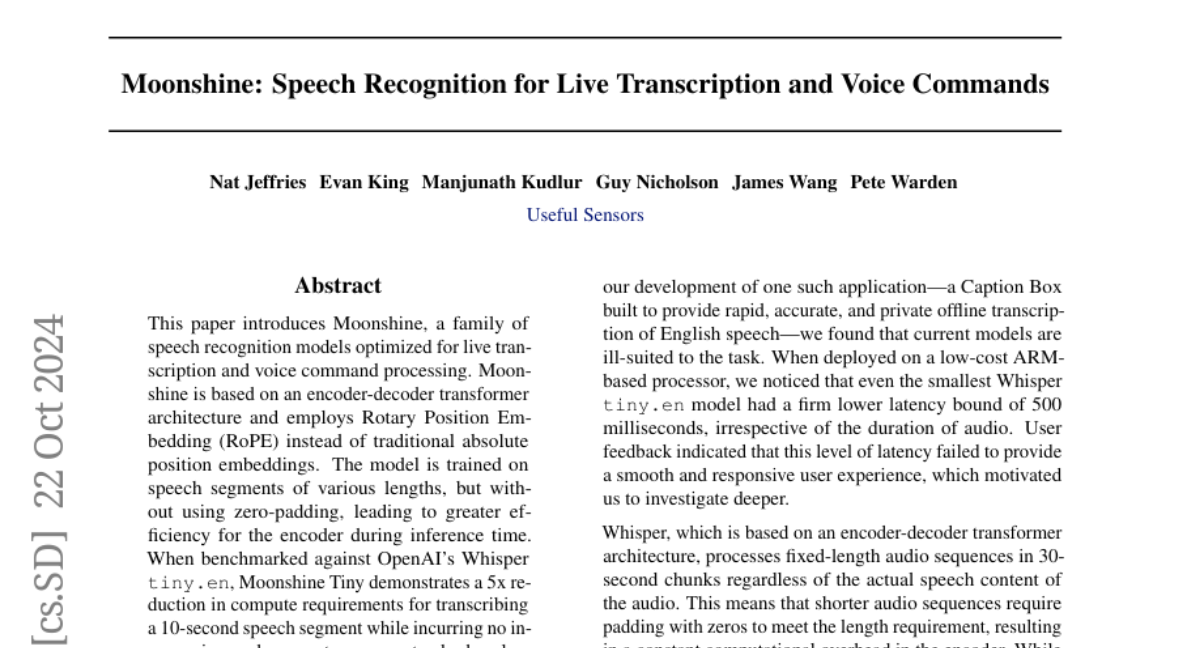
Moonshine: Speech Recognition for Live Transcription and Voice Commands

Moonshine, an encoder-decoder transformer architecture for speech recognition, uses Rotary Position Embedding, reducing compute requirements without decreasing accuracy.

  • 6 authors
· Oct 21, 2024
Submitted by
evanking

Flavors of Moonshine: Tiny Specialized ASR Models for Edge Devices

Monolingual ASR models trained on a balanced mix of high-quality, pseudo-labeled, and synthetic data outperform multilingual models for small model sizes, achieving superior error rates and enabling on-device ASR for underrepresented languages.

  • 5 authors
· Sep 2, 2025
Submitted by
taesiri

SkillOpt: Executive Strategy for Self-Evolving Agent Skills

SkillOpt introduces a systematic text-space optimizer for agent skills that trains skills as external agent state with stable updates and zero deployment inference overhead, achieving superior performance across multiple benchmarks and execution environments.

MicrosoftResearch Microsoft Research · May 22, 2026

TradingAgents: Multi-Agents LLM Financial Trading Framework

A multi-agent framework using large language models for stock trading simulates real-world trading firms, improving performance metrics like cumulative returns and Sharpe ratio.

  • 4 authors
· Dec 28, 2024
Submitted by
akhaliq

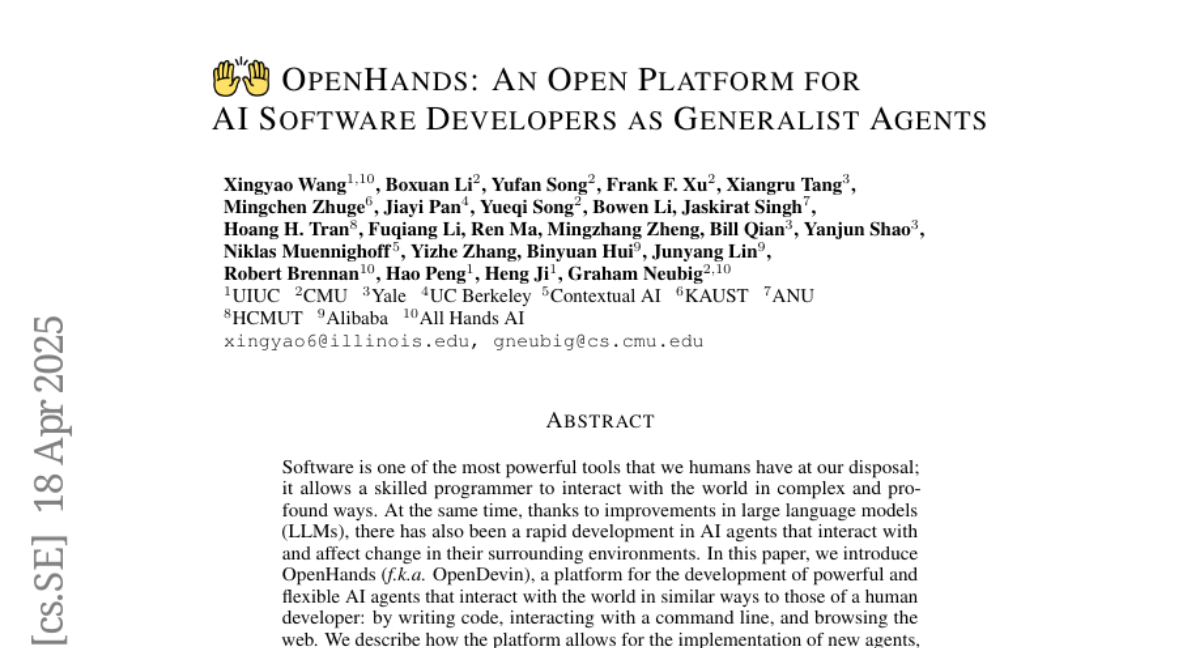
OpenDevin: An Open Platform for AI Software Developers as Generalist Agents

OpenDevin is a platform for developing AI agents that interact with the world by writing code, using command lines, and browsing the web, with support for multiple agents and evaluation benchmarks.

  • 24 authors
· Jul 23, 2024
Submitted by
YeWen27

Xiaomi-Robotics-1: Scaling Vision-Language-Action Models with over 100K Hours of Real-World Trajectories

We present Xiaomi-Robotics-1, a foundational vision-language-action (VLA) model capable of (1) following diverse language instructions to perform a wide range of mobile manipulation tasks in unseen environments out-of-the-box, and (2) efficiently adapting to novel downstream tasks with minimal fine-tuning data. We propose a two-stage training recipe consisting of pre-training and post-training. During pre-training, we imbue the model with broad and generalizable action-generation capabilities by training on over 100k hours of real-world manipulation trajectories collected via UMI devices. Crucially, we develop a scalable auto-labeling pipeline that annotates trajectory clips with natural languages describing scene state transitions, providing rich and precise conditioning for action learning. During post-training, we aim to align these capabilities with robot embodiments and imperative instructions that humans naturally use to prompt robots. Extensive experiments demonstrate strong scaling behavior. Xiaomi-Robotics-1 consistently improves with increased data scales and model sizes during pre-training. This scaling behavior directly transfers to post-training, where a stronger pre-training model yields better out-of-the-box real-robot performance in unseen environments. Furthermore, Xiaomi-Robotics-1 serves as a strong robot foundation policy that can be efficiently fine-tuned on complex, dexterous tasks with high data efficiency. Across multiple simulation benchmarks, Xiaomi-Robotics-1 outperforms state-of-the-art methods. Notably, it establishes a new state-of-the-art with a 57.6% success rate on RoboCasa365, surpassing the previous best of 46.6%. Furthermore, it achieves an average score of 20.07 on RoboDojo, significantly outperforming the prior state-of-the-art (13.07). Code and model checkpoints will be released. Project page: https://robotics.xiaomi.com/xiaomi-robotics-1.html

XiaomiRobotics Xiaomi Robotics · Jul 16, 2026
Submitted by
CNcreator0331

HOMIE: Human-object Centric Video Personalization via Multimodal Intelligent Enchancement

Human-object centric video personalization (HOCVP) is a core task within subject-driven video generation. However, existing methods suffer from two key limitations. First, most approaches focusing on inter-subject personalization still struggle to strike a balance between high subject fidelity and accurate interaction patterns between humans and diverse objects, especially when objects represent abstract concepts such as logos. Second, while intra-subject references (e.g., OCR maps, multi-view inputs) are expected to enhance subject fidelity, most existing works lack mechanisms to understand such latent correspondence. To address both challenges, we propose HOMIE, an HOCVP framework that tackles both inter- and intra-subject input settings in a unified manner. Compared to previous approaches, HOMIE proposes a better MLLM integration strategy to extract knowledge of reference-level relationships without compromising the controllability of text encoders or incurring costly re-alignment. Specifically, we introduce global multimodal guidance within self-attention to better align MLLM-derived semantic features with VAE tokens. Furthermore, we propose modality-reference embedding to differentiate tokens from MLLM features and VAE tokens and associate intra-subject reference image tokens. Extensive experiments validate that our method achieves state-of-the-art performance across various HOCVP tasks. Project Page: https://yiyangcai.github.io/homie-page.github.io/

  • 11 authors
· Jul 20, 2026
Submitted by
taesiri

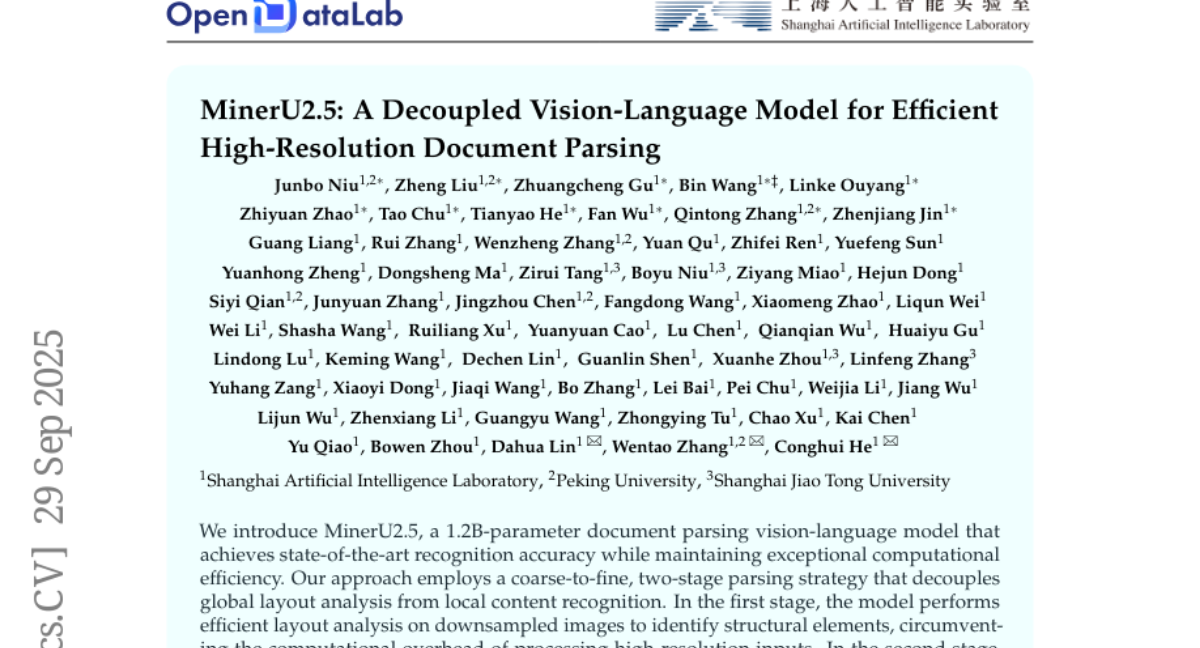
MinerU2.5: A Decoupled Vision-Language Model for Efficient High-Resolution Document Parsing

MinerU2.5, a 1.2B-parameter document parsing vision-language model, achieves state-of-the-art recognition accuracy with computational efficiency through a coarse-to-fine parsing strategy.

  • 61 authors
· Sep 26, 2025
Submitted by
akhaliq

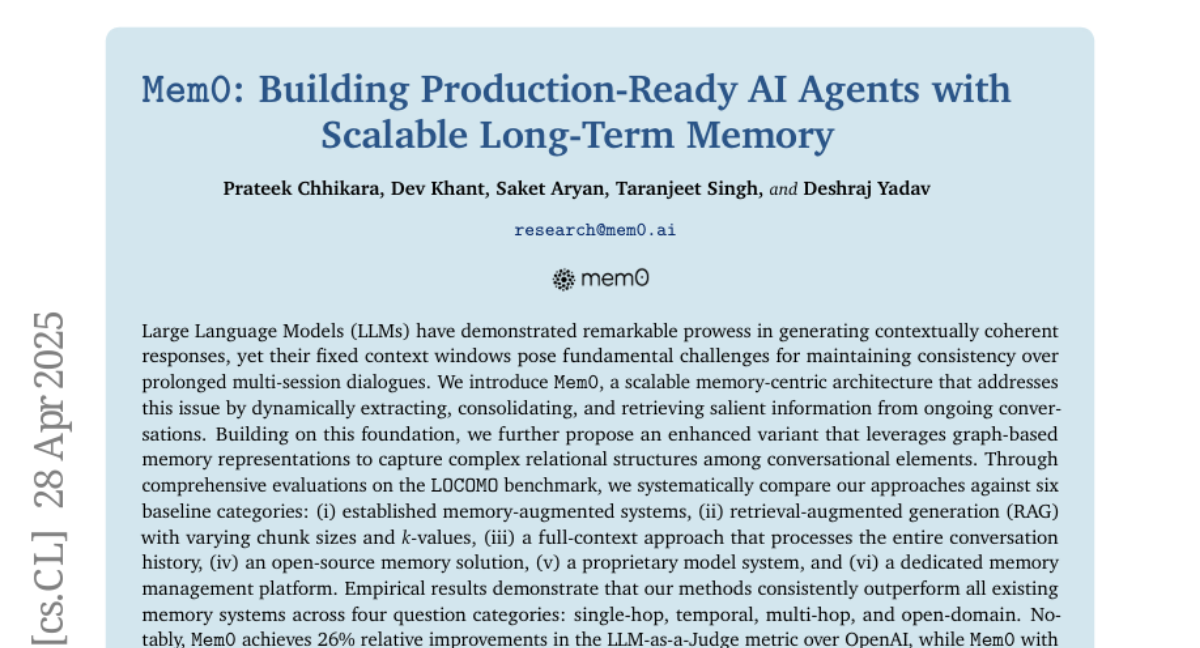
Mem0: Building Production-Ready AI Agents with Scalable Long-Term Memory

Mem0, a memory-centric architecture with graph-based memory, enhances long-term conversational coherence in LLMs by efficiently extracting, consolidating, and retrieving information, outperforming existing memory systems in terms of accuracy and computational efficiency.

  • 5 authors
· Apr 28, 2025
Submitted by
shanyou92

Kairos: A Native World Model Stack for Physical AI

Kairos is a world model framework that learns from diverse experiences, maintains persistent states through hybrid temporal attention mechanisms, and operates efficiently across different hardware platforms for physical AI applications.

  • 24 authors
· Jun 16, 2026

AutoDev: Automated AI-Driven Development

AutoDev is an AI-driven software development framework that automates complex engineering tasks within a secure Docker environment, achieving high performance in code and test generation.

  • 5 authors
· Mar 13, 2024
Submitted by
fistyyyy

ResearchStudio-Idea: An Evidence-Grounded Research-Ideation Skill Suite from ML Conference Outcomes

ResearchStudio-Idea provides a skill suite for effective research ideation that combines literature search, novelty checking, and pattern-guided generation to produce traceable research proposals.

microsoft Microsoft · Jul 5, 2026
Submitted by
akhaliq

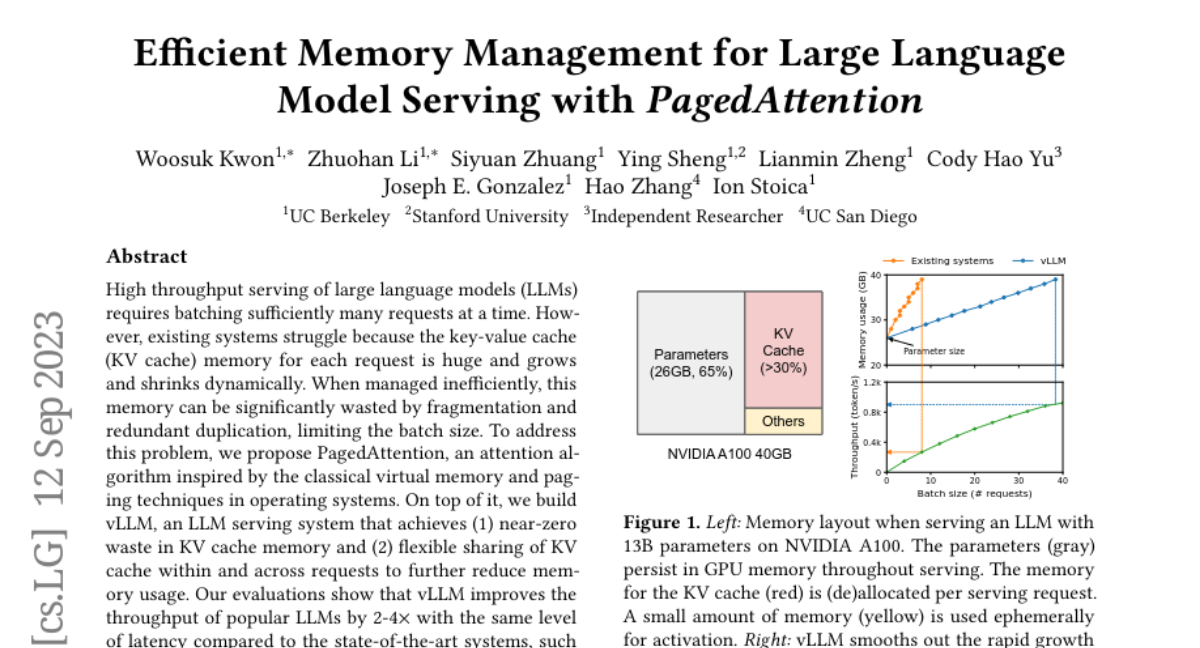
Efficient Memory Management for Large Language Model Serving with PagedAttention

PagedAttention algorithm and vLLM system enhance the throughput of large language models by efficiently managing memory and reducing waste in the key-value cache.

  • 9 authors
· Sep 12, 2023
Submitted by
ChengCui

PaddleOCR-VL-1.6: Expanding the Frontier of Document Parsing with Under-Optimized Region Refinement and Progressive Post-Training

PaddleOCR-VL-1.6 enhances document parsing performance through targeted data optimization and progressive post-training techniques, achieving state-of-the-art results on OmniDocBench v1.6.

PaddlePaddle PaddlePaddle · Jun 2, 2026
Submitted by
Paranioar

SenseNova-U1: Unifying Multimodal Understanding and Generation with NEO-unify Architecture

Unified vision-language models treat understanding and generation as integrated processes rather than separate tasks, demonstrating strong performance across multiple multimodal capabilities including image synthesis and action reasoning.

sensenova SenseNova · May 12, 2026
Submitted by
taesiri

Infinite Worlds with Versatile Interactions

An advanced world modeling system with extended interaction capabilities, real-time processing, diverse interactive elements, and multi-agent behavior control for collaborative virtual environments.

robbyant Robbyant · Jul 8, 2026

Continuous Audio Language Models

Audio Language Models (ALM) have emerged as the dominant paradigm for speech and music generation by representing audio as sequences of discrete tokens. Yet, unlike text tokens, which are invertible, audio tokens are extracted from lossy codecs with a limited bitrate. As a consequence, increasing audio quality requires generating more tokens, which imposes a trade-off between fidelity and computational cost. We address this issue by studying Continuous Audio Language Models (CALM). These models instantiate a large Transformer backbone that produces a contextual embedding at every timestep. This sequential information then conditions an MLP that generates the next continuous frame of an audio VAE through consistency modeling. By avoiding lossy compression, CALM achieves higher quality at lower computational cost than their discrete counterpart. Experiments on speech and music demonstrate improved efficiency and fidelity over state-of-the-art discrete audio language models, facilitating lightweight, high-quality audio generation. Samples are available at https://continuous-audio-language-models.github.io

  • 5 authors
· Sep 8, 2025
Submitted by
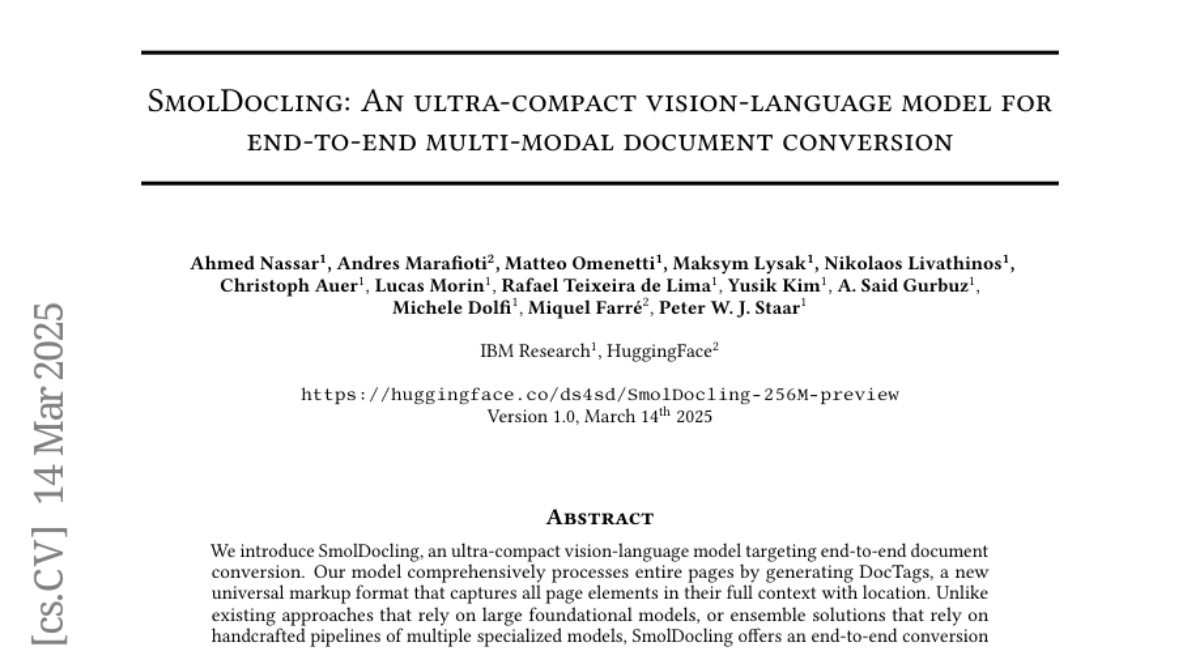
andito

SmolDocling: An ultra-compact vision-language model for end-to-end multi-modal document conversion

SmolDocling is a compact vision-language model that performs end-to-end document conversion with robust performance across various document types using 256M parameters and a new markup format.

ibm-granite IBM Granite · Mar 14, 2025
Submitted by
YunxinLi

KnowAct-GUIClaw: Know Deeply, Act Perfectly, Personal GUI Assistant with Self-Evolving Memory and Skill

OpenClaw has emerged as a leading agent framework for complex task automation, yet it faces insufficient cross-platform GUI interaction support and a well-built self-evolution mechanism. These flaws limit its adaptation to diverse device ecosystems and prevent performance improvements through continuous learning from execution experience. To resolve these issues, we propose the Know Deeply, Act Perfectly paradigm for personal assistants, which holds that accumulated user interaction and task-running experience directly improve execution accuracy and efficiency, unifying cognitive comprehension and operational execution. Based on this paradigm, we introduce KnowAct-GUIClaw, a novel Know-Route-Act-Reflect framework designed to address OpenClaw's GUI manipulation deficits and break through its cross-platform and recursive self-improvement constraints. First, the host agent leverages accumulated interaction experience and task-relevant knowledge for long-horizon task decomposition and allocation (Know). Second, a pluggable GUI subagent with an experience-attributable memory system (Know) and self-evolving skill library (Act), enabling seamless cross-platform migration and fast-path integration. Especially, this framework continuously stores user profiles and feedback to improve the accuracy of task decomposition and tool calls. Extensive experiments across Android, iOS, HarmonyOS and Windows show that KnowAct-GUIClaw achieves superior efficiency, accuracy and cross-platform adaptability. Especially, the GUIClaw with open-source Kimi-2.6 models achieves the best performance (64.1%) on the long-horizon MobileWorld benchmark, beating all agentical frameworks and closed-source agentical models, e.g., Seed-2.0-Pro and GPT-5.5. Additionally, the knowledgeable memory and execution skills supported by our framework are transferable across diverse base models, improving by 8.5% with Kimi-2.6.

HIT-TMG Lychee Team · Jul 15, 2026

EverMemOS: A Self-Organizing Memory Operating System for Structured Long-Horizon Reasoning

EverMemOS presents a self-organizing memory system for large language models that processes dialogue streams into structured memory cells and scenes to enhance long-term interaction capabilities.

  • 11 authors
· Jan 5, 2026
Submitted by
Yif29

RESOURCE2SKILL: Distilling Executable Agent Skills from Human-Created Multimodal Resources

Skills are a useful abstraction for software agents, turning human and agent experience into reusable procedural knowledge. Yet existing skill libraries are mostly hand-written, text-centric, or derived from agent traces, leaving tutorial videos and other multimodal human resources largely underused. We present RESOURCE2SKILL, a framework that distills multimodal resources, including tutorial videos, repositories, articles, and reference artifacts, into executable skills for software agents. RESOURCE2SKILL organizes these skills as a hierarchical multimodal Skill Wiki, where each entry combines structured text, code, visual examples, metadata, and provenance. This design preserves complementary signals from different resources: videos capture temporal operations and visual effects, code captures executable tool patterns, and articles or artifacts provide conceptual and stylistic grounding. At inference time, agents retrieve and compose relevant skills from the wiki; when coverage is insufficient, the same construction operator can acquire new skills online. Across seven practical authoring domains, RESOURCE2SKILL improves average overall score by +11.9 percentage points over no-skill agents and outperforms strong harness baselines in 26 of 28 main-aggregate model-domain cells. Ablations confirm the value of multimodal skill format, hierarchical organization, source diversity, selection strategy, and online acquisition.

MicrosoftResearch Microsoft Research · Jul 16, 2026
Submitted by
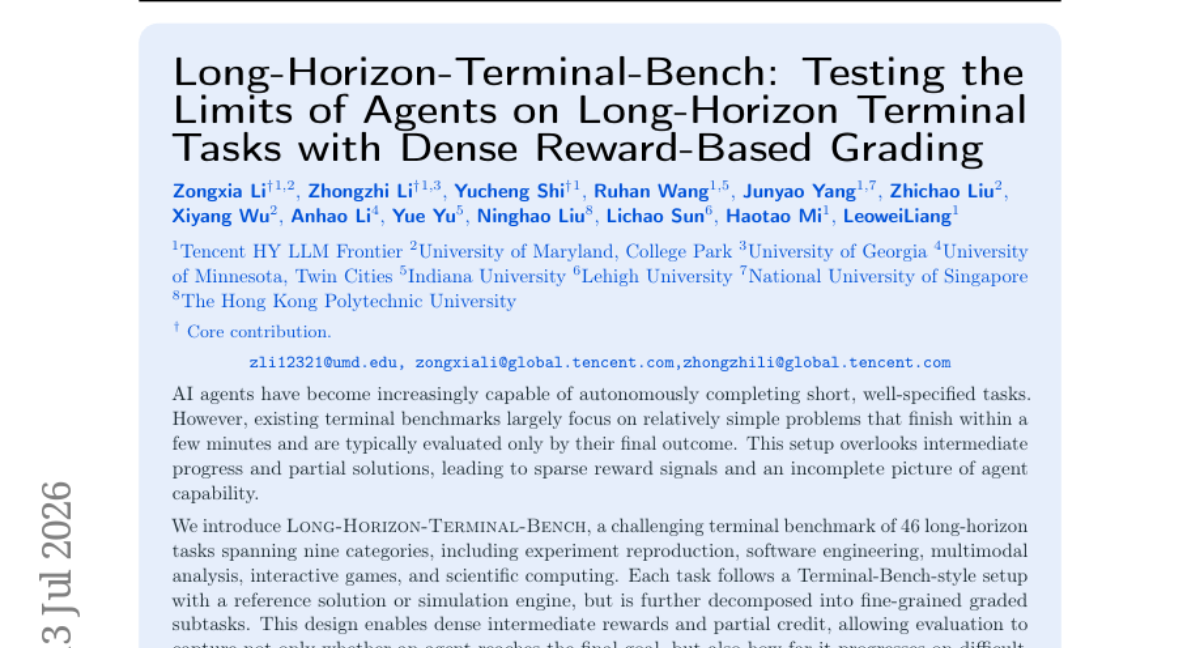
zli12321

Long-Horizon-Terminal-Bench: Testing the Limits of Agents on Long-Horizon Terminal Tasks with Dense Reward-Based Grading

AI agents have become capable of autonomously completing short, well-specified tasks. However, existing terminal benchmarks largely focus on simple problems that finish within minutes and are evaluated only by their final outcome. This setup overlooks intermediate progress and partial solutions, yielding sparse reward signals and an incomplete picture of agent capability. We introduce Long-Horizon-Terminal-Bench, a terminal benchmark of 46 long-horizon tasks spanning nine categories, including experiment reproduction, software engineering, multimodal analysis, interactive games, and scientific computing. Each task follows a Terminal-Bench-style setup with a reference solution or simulation engine, but is further decomposed into fine-grained graded subtasks. This design enables dense intermediate rewards and partial credit, allowing evaluation to capture not only whether an agent reaches the final goal, but also how far it progresses on open-ended workflows. Tasks in Long-Horizon-Terminal-Bench typically require hundreds of episodes and minutes to hours of execution, stressing long-horizon planning, long-context management, and iterative debugging rather than one-shot problem solving. We evaluate 15 frontier models and find that agents consume on average 9.9M tokens per task, with roughly 231 episodes and 85.3 minutes of execution time per run, making Long-Horizon-Terminal-Bench more demanding than prior terminal-based benchmarks. Even the strongest tested model achieves 15.2% pass@1 at a partial-reward threshold of 0.95 and 10.9% at a perfect-reward threshold of 1.0, while the mean pass rate across models is 4.3% and 1.7% under the two thresholds, respectively. These results reveal headroom for improvement. We further analyze failure modes and error patterns, and release Long-Horizon-Terminal-Bench to support future progress on long-horizon terminal agents.

Tencent-Hunyuan Tencent Hunyuan · Jul 9, 2026
Submitted by
bond005

RAGU: A Multi-Step GraphRAG Engine with a Compact Domain-Adapted LLM

Graph retrieval-augmented generation (GraphRAG) enhances large language models with structured knowledge, yet existing systems construct knowledge graphs in a single extraction pass, producing noisy entities and brittle retrieval. RAGU, an open-source modular GraphRAG engine, addresses this by separating extraction from consolidation: entities and relations pass through two-stage typed extraction, DBSCAN-backed deduplication, LLM summarization, and Leiden community detection. A key insight motivates a compact extractor: the skills an in-pipeline LLM needs - comprehension, extraction, reasoning over context - are language skills that grow only weakly with model size, unlike factual world knowledge. Accordingly, we train Meno-Lite-0.1, a 7B model optimized for language skills, which outperforms Qwen2.5-32B on knowledge-graph construction (+12.5% relative harmonic mean) and matches it on English GraphRAG tasks. On GraphRAG-Bench (Medical), RAGU retrieves the most complete context at every factoid level (evidence recall up to 0.84 vs. leq0.76) and overtakes HippoRAG2 on synthesis tasks; on multi-hop factoid QA, the apparent HippoRAG2 advantage is shown to be largely an answer-format artifact. RAGU is installable via pip install graph_ragu, runs on a single GPU, and is released under MIT. The source code is publicly available at https://github.com/RaguTeam/RAGU, and the Meno-Lite-0.1 model can be obtained from https://huggingface.co/bond005/meno-lite-0.1.

Submitted by
zbhpku

DataFlow: An LLM-Driven Framework for Unified Data Preparation and Workflow Automation in the Era of Data-Centric AI

DataFlow is an LLM-driven data preparation framework that enhances data quality and reproducibility for various tasks, improving LLM performance with automatically generated pipelines.

PekingUniversity Peking University · Dec 18, 2025
Submitted by
Jinyang23

SEED: Self-Evolving On-Policy Distillation for Agentic Reinforcement Learning

Large language models are increasingly trained as interactive agents for long-horizon tasks involving multi-turn interaction, tool use, and environment feedback. Outcome-based reinforcement learning (RL) provides a practical optimization paradigm, but its sparse trajectory-level rewards offer limited guidance on intermediate decisions, leaving a supervision gap between episode-level outcomes and token-level policy learning. We propose SEED (SElf-Evolving On-Policy Distillation), a self-evolving framework that converts completed on-policy trajectories into training-time hindsight skills and distills their behavioral effect back into the policy model. SEED first fine-tunes the policy to analyze completed trajectories and generate natural-language skills that capture reusable workflows, decisive observations, or failure-avoidance rules. During RL, the current policy both collects trajectories and serves as the analyzer that extracts hindsight skills from them. Policy updates therefore improve subsequent decision making and skill analysis together, allowing hindsight supervision to evolve with the policy. SEED then re-scores the sampled actions under ordinary and skill-augmented contexts, converting the skill-induced probability shift into a dense token-level on-policy distillation signal. This signal is jointly optimized with outcome-based RL, keeping the auxiliary supervision aligned with the current trajectory distribution. Extensive experiments on text-based and vision-based agentic tasks show that SEED consistently improves performance and sample efficiency, exhibiting robust generalization to unseen scenarios. Our code is available at https://github.com/jinyangwu/SEED.

  • 11 authors
· Jul 16, 2026

LightRAG: Simple and Fast Retrieval-Augmented Generation

LightRAG improves Retrieval-Augmented Generation by integrating graph structures for enhanced contextual awareness and efficient information retrieval, achieving better accuracy and response times.

  • 5 authors
· Oct 8, 2024
Submitted by
taesiri

AgentScope 1.0: A Developer-Centric Framework for Building Agentic Applications

AgentScope enhances agentic applications by providing flexible tool-based interactions, unified interfaces, and advanced infrastructure based on the ReAct paradigm, supporting efficient and safe development and deployment.

  • 23 authors
· Aug 22, 2025

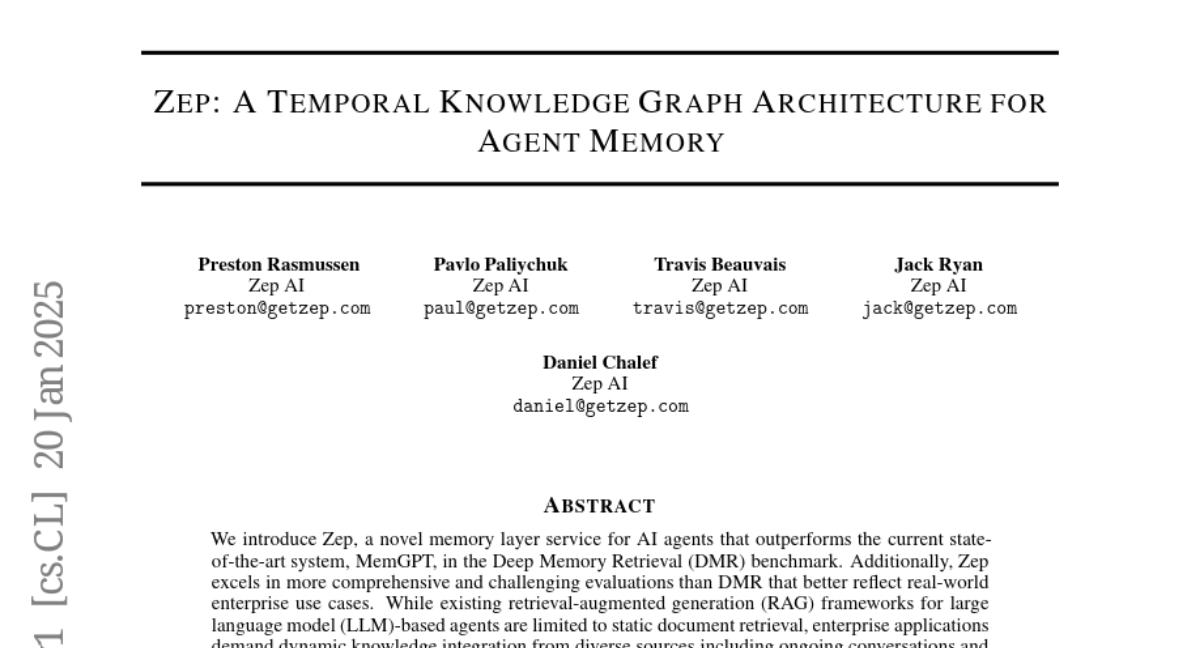
Zep: A Temporal Knowledge Graph Architecture for Agent Memory

Zep, a memory layer service, outperforms MemGPT in the DMR benchmark and LongMemEval by excelling in dynamic knowledge integration and temporal reasoning, critical for enterprise use cases.

  • 5 authors
· Jan 20, 2025
Submitted by
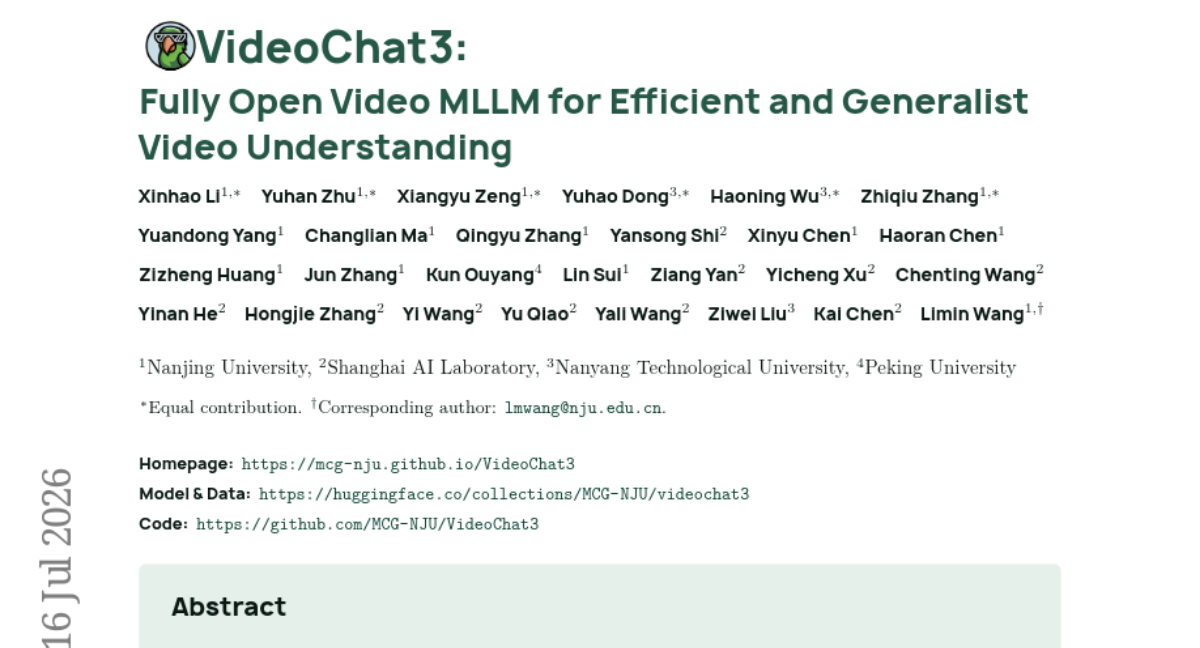
lmwang

VideoChat3: Fully Open Video MLLM for Efficient and Generalist Video Understanding

Recent advances in video understanding have spanned motion, long video, and streaming interaction, driving this field toward real-world applications. Despite this progress, current open-source models remain limited in several ways. They often struggle to generalize across diverse video types, making them effective only in specific domains. High computational demands further restrict their efficiency and scalability. Moreover, most models are only partially open, with key components such as training code, strategy, or datasets unavailable, which hinders reproducibility and slows community-driven development. To address these issues, we introduce VideoChat3, a fully open, efficient, and generalist video-centric MLLM. VideoChat3 advances video understanding through two complementary designs. For efficiency, we introduce Inflated 3D Vision Transformer (I3D-ViT) and Adaptive Frame Resolution for Streaming Video Perception, which enables efficient spatiotemporal representation and reduces the cost of processing video inputs during training and inference. For effectiveness, we develop a scalable video data synthesis pipeline that curates three diverse, high-quality training datasets: VideoChat3-Academic2M, VideoChat3-LV116K, and VideoChat3-OL617K, covering general, long-form, and streaming video scenarios, improving the model's generalization across domains. By integrating these designs, VideoChat3 achieves a rare balance of broad generalization and computational efficiency. Experiments across general, long-form, and streaming benchmarks demonstrate that VideoChat3 surpasses prior open-source models with equal or larger parameter counts with only 4B parameters and higher efficiency.


Submitted by
akhaliq

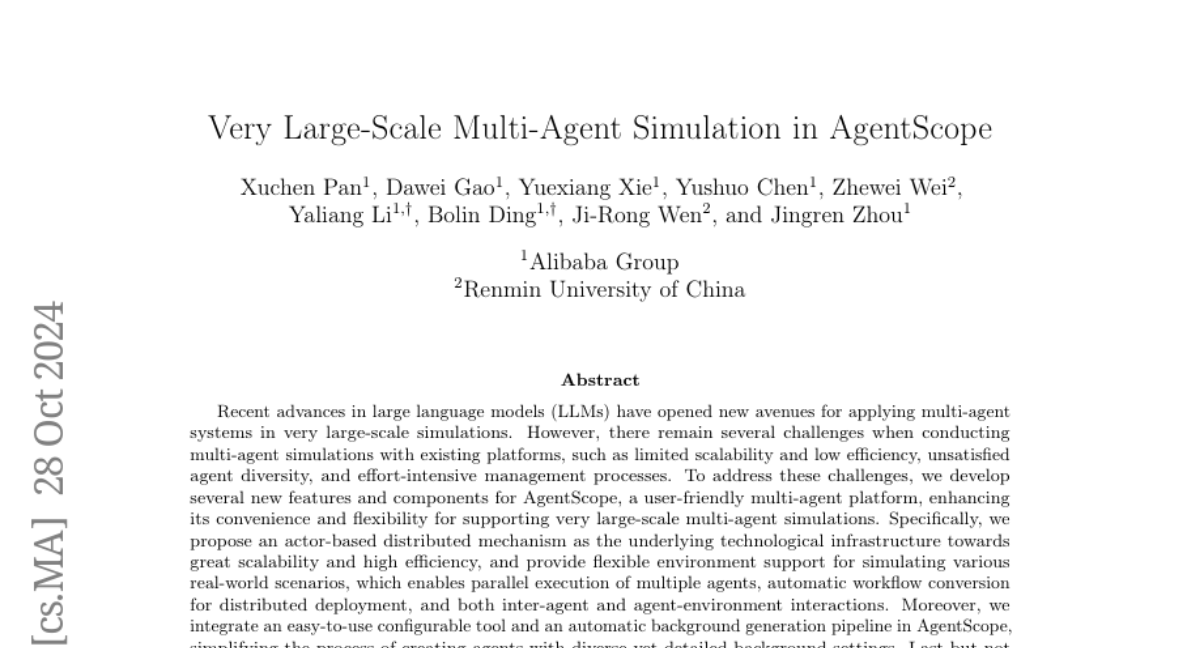
Very Large-Scale Multi-Agent Simulation in AgentScope

Enhancements to the AgentScope platform improve scalability, efficiency, and ease of use for large-scale multi-agent simulations through distributed mechanisms, flexible environments, and user-friendly tools.

  • 8 authors
· Jul 25, 2024
Submitted by
taesiri

Scaling Mixture-of-Experts Video Pretraining for Embodied Intelligence

LingBot-Video presents a DiT-based video pretraining framework with Mixture-of-Experts architecture, specialized data augmentation, and multi-dimensional reward system for embodied intelligence applications.

robbyant Robbyant · Jul 8, 2026
Submitted by
RuofengYang

ARIS: Autonomous Research via Adversarial Multi-Agent Collaboration

ARIS is an open-source research harness that uses cross-model adversarial collaboration to ensure reliable long-term research outcomes through coordinated execution, orchestration, and assurance layers.

LMCache: An Efficient KV Cache Layer for Enterprise-Scale LLM Inference

LMCACHE enables efficient KV cache management for large language models by storing caches outside GPU memory, supporting cache reuse across queries and inference engines while achieving significant throughput improvements.

  • 11 authors
· Oct 8, 2025
Submitted by
taesiri

AlayaWorld: Long-Horizon and Playable Video World Generation

AlayaWorld is an open-source framework for creating interactive generative worlds that enables real-time user interaction and supports diverse actions within a modular architecture.

  • 17 authors
· Jul 7, 2026
Submitted by
ameroyer

MuScriptor: An Open Model for Multi-Instrument Music Transcription

Existing methods for automatic music transcription are often limited to single-instrument recordings or fail on complex, real music mixes. Although previous work utilizes synthetic training data, the resulting models generalize poorly, leading to largely unusable transcription output in realistic, multi-instrument settings. In this work, we analyze the effectiveness of synthetic data for pre-training while combining it with fine-tuning on real music audio and post-training using reinforcement learning. We further introduce conditioning on instrument presence to customize transcriptions. Finally, we release MuScriptor, an open-weight multi-instrument music transcription model that works on real-world music recordings from across a diverse range of musical genres.

kyutai Kyutai · Jul 9, 2026
Submitted by
unilm

VibeVoice Technical Report

VibeVoice synthesizes long-form multi-speaker speech using next-token diffusion and a highly efficient continuous speech tokenizer, achieving superior performance and fidelity.

MicrosoftResearch Microsoft Research · Aug 26, 2025

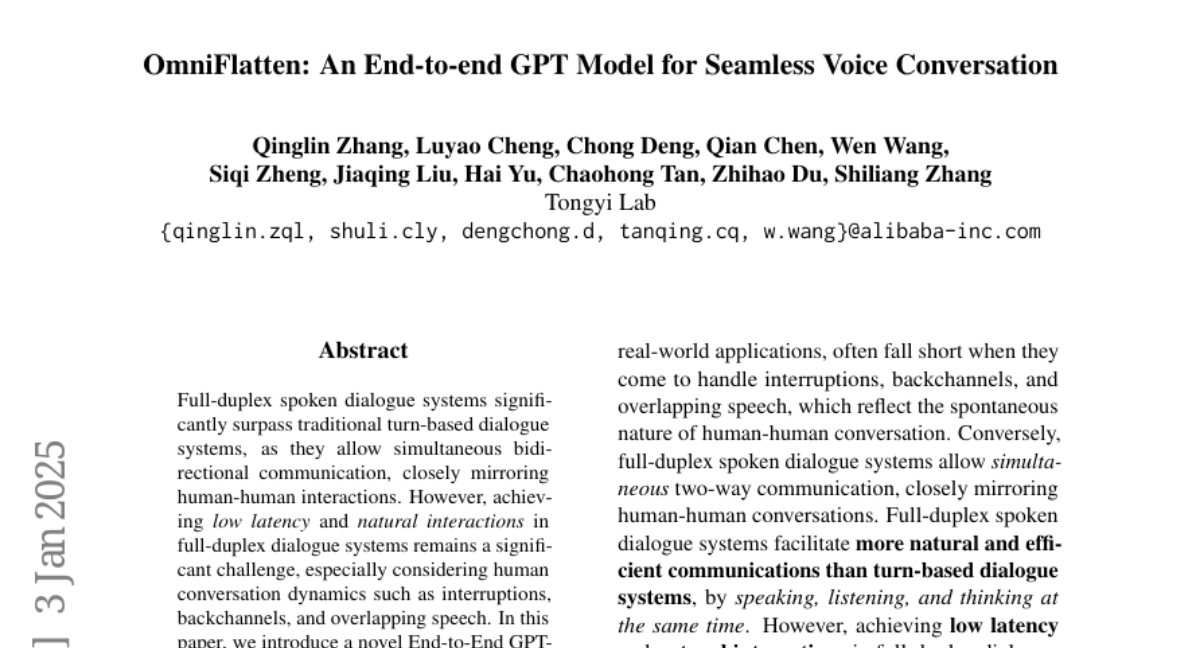
OmniFlatten: An End-to-end GPT Model for Seamless Voice Conversation

A novel GPT-based model, OmniFlatten, enables real-time natural full-duplex spoken dialogue through a multi-stage post-training technique that integrates speech and text without altering the original model's architecture.

  • 9 authors
· Oct 23, 2024
Submitted by
nielsr

Ultralytics YOLO26: Unified Real-Time End-to-End Vision Models

YOLO26 addresses real-time vision challenges through a unified model family with NMS-free inference, improved training strategies, and multi-task capabilities spanning detection, segmentation, and pose estimation.

Ultralytics Ultralytics · Jun 2, 2026
Submitted by
Lanxingxuan

TimeLens2: Generalist Video Temporal Grounding with Multimodal LLMs

Video multimodal large language models (MLLMs) can describe what happens in a video, but rarely identify when the supporting evidence occurs. We study generalist video temporal grounding, in which one model predicts a variable-cardinality set of evidence intervals across video lengths, domains, query forms, and viewpoints. Existing training strategies are misaligned with this set-valued task: long-video labels often rely on brittle one-pass annotation, while reinforcement-learning rewards either fail to distinguish non-overlapping predictions or require fragile segment matching. TimeLens2 treats temporal evidence as an interval set throughout supervision and optimization. TimeLens2-93K constructs reliable multi-span supervision through caption-derived proposals, independent localization, cross-agent consensus, semantic verification, and boundary refinement. Our temporal Wasserstein reward computes exact one-dimensional \(W_1\) between uniform distributions over merged interval supports, providing dense, matching-free feedback under unequal cardinalities and equivalent fragmentation; temporal IoU complements it with precise-overlap feedback. Across seven benchmarks, TimeLens2-2B outperforms all size-matched baselines on every benchmark, while the 4B and 8B variants achieve state-of-the-art performance, surpassing open-source models with up to 397B parameters. The 2B, 4B, and 8B variants improve over their Qwen3-VL backbones by 14.2, 13.0, and 18.1 mIoU points, respectively.
Submitted by
KumaPower

OPSD-V: On-Policy Self-Distillation for Post-Training Few-Step Autoregressive Video Generators

OPSD-V enhances few-step autoregressive video diffusion models by using real long-video data for temporal context during training, providing dense trajectory-level supervision that improves visual quality and motion dynamics without altering inference mechanisms.

MeiGen-AI MeiGen-AI · Jul 9, 2026
Submitted by
shixuanke

Vision as Unified Multimodal Generation

A unified multimodal model formulates computer vision tasks as generation problems using natural language and visual prompts, achieving performance comparable to specialized systems across diverse vision tasks.

sensenova SenseNova · Jul 7, 2026

Efficient Guided Generation for Large Language Models

An efficient method guides language model text generation using regular expressions and context-free grammars with minimal overhead.

  • 2 authors
· Jul 19, 2023
Submitted by
andito

SmolVLA: A Vision-Language-Action Model for Affordable and Efficient Robotics

SmolVLA is a compact, efficient vision-language-action model that achieves competitive performance at reduced computational costs and can be deployed on consumer-grade hardware.

  • 14 authors
· Jun 2, 2025

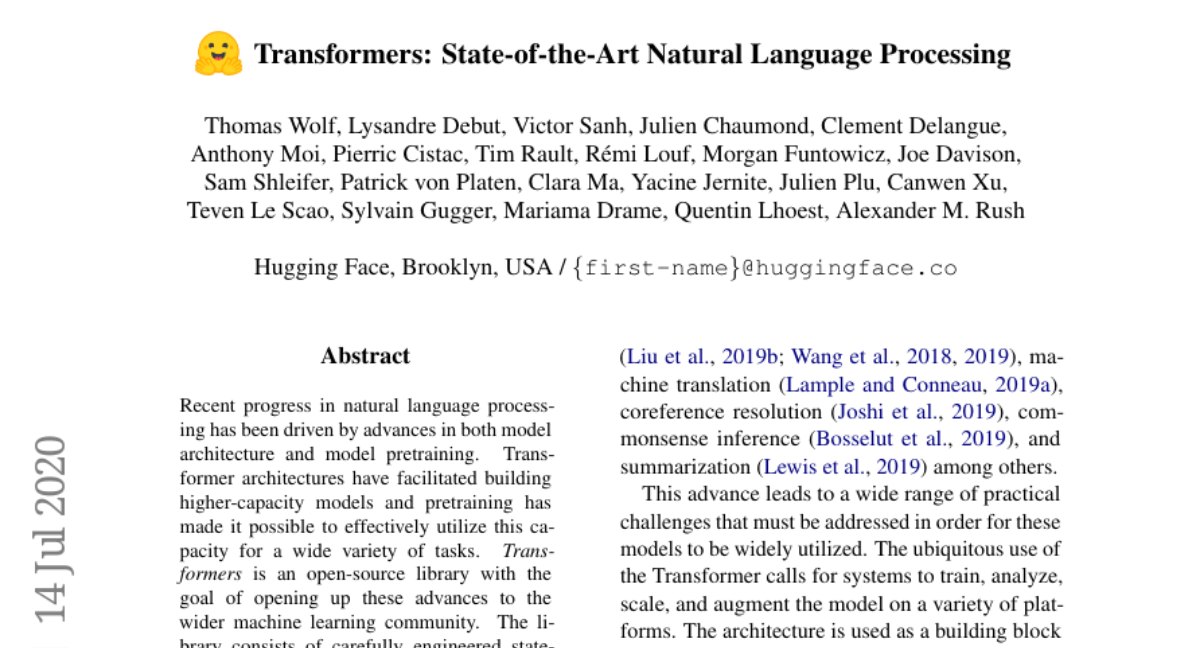
HuggingFace's Transformers: State-of-the-art Natural Language Processing

Transformers library provides state-of-the-art Transformer architectures and pretrained models for natural language processing tasks with a unified API and emphasis on extensibility and robust deployment.

huggingface Hugging Face · Oct 9, 2019
Submitted by
Jeff-Wang

GigaWorld-1: A Roadmap to Build World Models for Robot Policy Evaluation

World models for robotic policy evaluation are systematically studied through a new benchmark, revealing that long-horizon rollout consistency and robot-specific controllability are more important than short-term visual realism for reliable policy assessment.

open-gigaai GigaAI · Jul 2, 2026
Submitted by
aHapBean

xHC: Expanded Hyper-Connections

Hyper-Connections (HC) expand the residual stream of Transformers into N parallel streams, providing a form of memory scaling beyond model width and depth. Manifold-Constrained HC (mHC) stabilizes this formulation at scale. The large gains from N{=}1 to N{=}4 suggest residual-stream expansion as a promising scaling axis. However, existing HC-family methods typically stop at N{=}4. Our experiments reveal why: scaling mHC beyond this point yields diminishing performance gains and rapidly increasing training cost. We attribute this limitation to two bottlenecks: insufficient write-back information for an expanding number of streams and residual-mixing generation whose cost scales cubically with N. To address both bottlenecks, we propose xHC (Expanded Hyper-Connections), the first HC-family method to achieve meaningful expansion beyond N{=}4. xHC combines temporal feature augmentation for richer write-back with a sparse residual-stream architecture that updates only k=4 of the N=16 streams while retaining dense access to the full residual state. Across 18B and 28B MoE models, xHC delivers strong and consistent downstream improvements. On an 18B MoE model, xHC improves the average downstream score by 4.0 points over mHC, while adding only modest training FLOPs over the vanilla baseline. Scaling-law experiments show that the vanilla and mHC require 1.50times and 1.19times the compute of xHC, respectively, to reach the same loss. Practical large-N training also requires controlling memory traffic from the expanded residual state. We therefore introduce xHC-Flash, which reduces the per-sublayer memory traffic from 73.5C to 40C, comparable to the 34C required by mHC at N{=}4, while retaining the gains of full xHC. Together, xHC and xHC-Flash make large-N residual-stream expansion effective and practical for LLM pre-training.

dots-studio dots studio · Jul 16, 2026

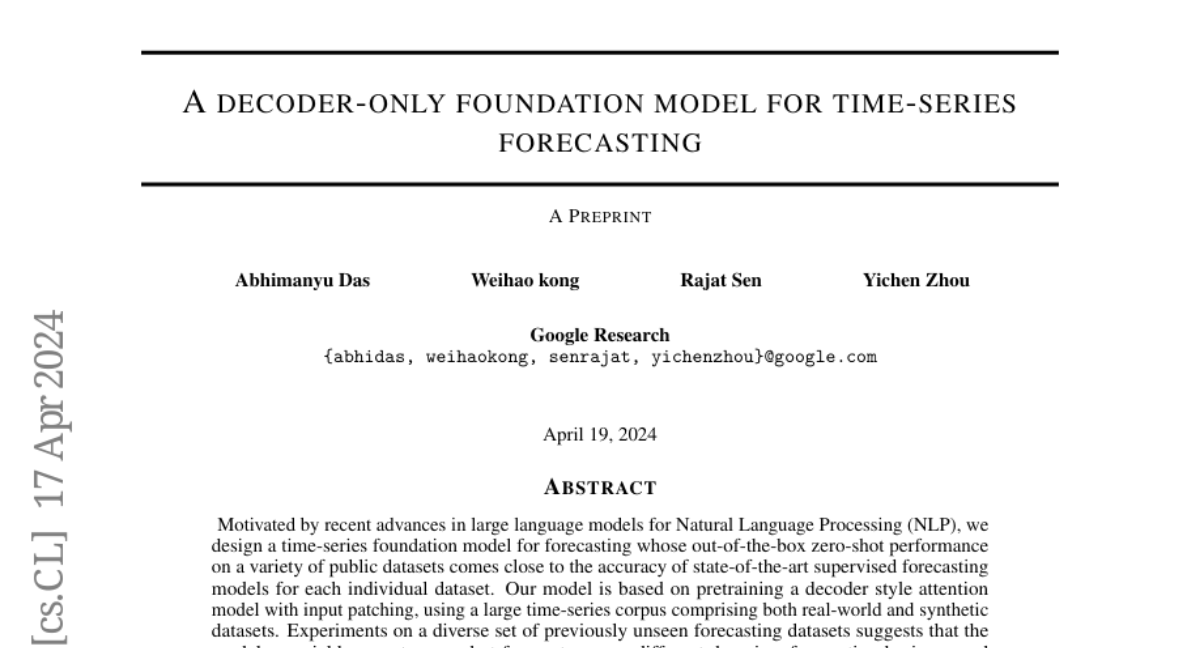
A decoder-only foundation model for time-series forecasting

A large language model adapted for time-series forecasting achieves near-optimal zero-shot performance on diverse datasets across different time scales and granularities.

  • 4 authors
· Oct 14, 2023
Submitted by
akhaliq

LlamaFactory: Unified Efficient Fine-Tuning of 100+ Language Models

LlamaFactory is a unified framework enabling efficient fine-tuning of large language models across various tasks using a web-based user interface.

  • 5 authors
· Mar 20, 2024